
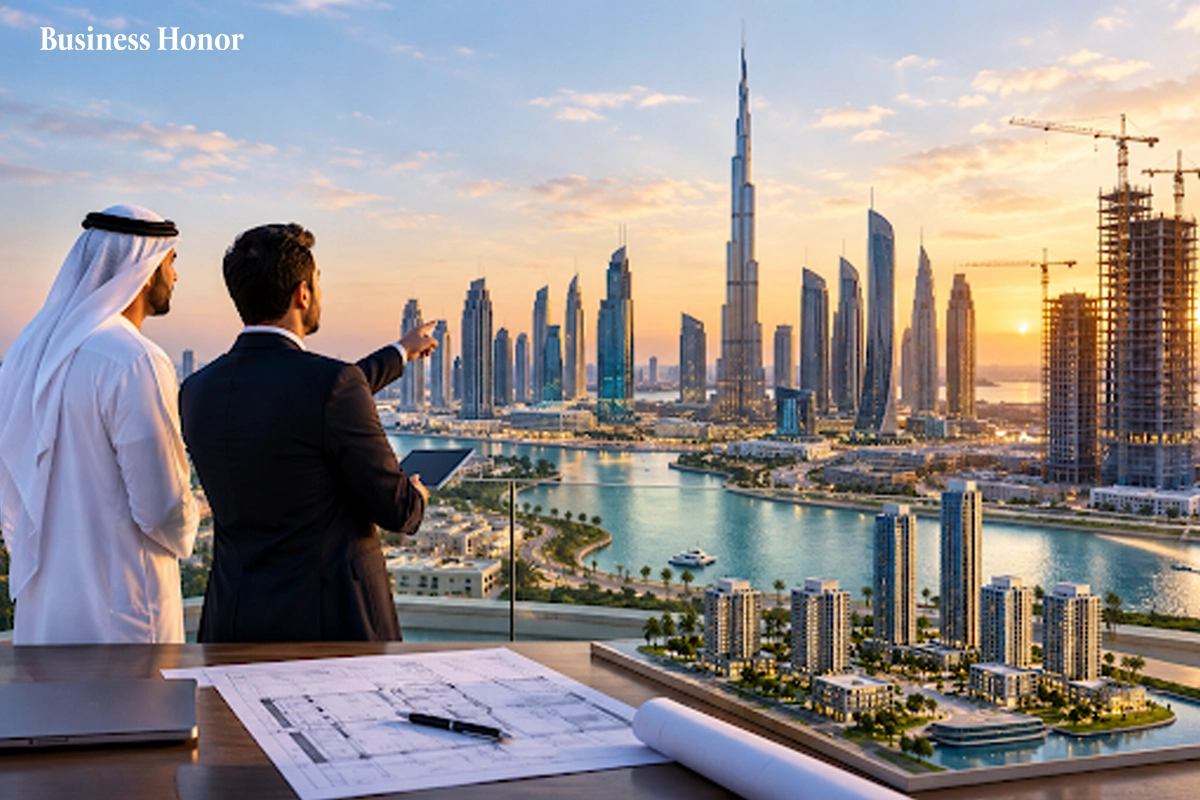
The top Middle East real estate companies to watch in 2027 have one thing in common. They build where policy is heading, not where prices already peaked.
You could see it in the last few weeks. In October, Sharjah-born Arada launched a Saudi arm with a SAR 50 billion land bank behind it. In September, DAMAC said it had handed over more than 50,000 homes. On 27 October, United Development Company put 150 new villas up for sale at Cityscape Qatar. Three countries, same story. Developers are shifting from launching projects to finishing them, and from home turf to the neighbours.
That shift tells investors more than any single launch does. It shows who has the land, the cash and the builders to last through a crowded cycle. This is a watchlist, not a Business Honor real estate industry ranking built on revenue alone. It singles out the Middle East property development leaders whose next moves matter most.
Why 2027 Looks Different
Start with money. It pools in the UAE. Forbes Middle East’s 2026 report on the region’s most impactful real estate leaders counted 47 leaders from the UAE and 21 from Saudi Arabia, as Realty Today summarised it.
Policy comes next. Saudi Arabia’s Law of Real Estate Ownership by Non-Saudis, issued under Royal Decree No. M/14, took effect in January 2026. It opens set zones to foreign buyers, and ownership only counts once it is recorded in the national real estate registry.
Philip Corfield-Smith of Pinsent Masons called it “an excellent initial step toward encouraging foreign ownership.”
Then there is supply. Cushman & Wakefield numbers cited in DAMAC’s September update show nearly 25,000 homes finished in Dubai in the first half of 2026, up 36%. About 32,000 more are due in the second half. What happens to prices when keys, not brochures, set the agenda?
Top Middle East Real Estate Companies to Watch in 2027
Ten names, grouped by country. I weighed their portfolios, their reach and how exposed they are to the shifts above.
UAE
1. Emaar Properties
Emaar Properties claims the top spot among the Top Middle East Real Estate Companies to watch, as ranked by Business Honor in its latest industry report. Emaar booked record property sales of AED 80.4 billion in 2025, up 16%, and its revenue backlog stands at AED 155 billion.
Founder Mohamed Alabbar credited “the clear vision that continues to shape Dubai.”
Keep an eye on that backlog. It shows how much revenue is already signed and how fast Emaar can turn it into handovers. Khaleej Times data puts it first among Dubai developers by transaction value, and Gulf Business counts it among the region’s most iconic companies.
2. DAMAC Properties
DAMAC says it has delivered more than 50,000 homes and has over 55,000 more in the pipeline. It also awarded more than AED 10 billion in construction contracts in the first half of 2026, Khaleej Times reports.
Chief Project Officer Mohammad Tahaineh put it plainly: “the next 55,000+ demand rigorous control at every stage.”
Those are the company’s own figures. 2027 will show whether the deliveries match.
3. Aldar Properties
Abu Dhabi’s Aldar builds property and also holds it. It works across the UAE, the wider MENA region and Europe, and Forbes Middle East puts its market value near $20.5 billion. The investment side brings steady income. That helps if Dubai’s supply wave drags on prices.
4. Arada
Arada KSA opens with a 10 million square metre land bank valued at SAR 50 billion. Its first project is a SAR 14 billion community of about 3,500 villas and townhouses in Riyadh’s Al Rimal district, Asharq Al-Awsat reports. The chief executive told The National the company wants 100,000 Saudi homes within three to five years, and TradeArabia covered the launch too. Big goal. But a land valuation is not money spent.
5. Al-Futtaim Real Estate
Part of the Al-Futtaim Group, it runs Dubai Festival City and has Festival City projects in Doha and Cairo. Its pitch is spread across three markets rather than headline launches.
Saudi Arabia
6. ROSHN Group
Owned by the Public Investment Fund, ROSHN builds whole communities, such as SEDRA in Riyadh and Al Arous in Jeddah, which is planned for 18,000 homes. Gulf Business reports that Naaman Atallah became group CEO in September 2026, taking over from acting CEO Sabah Barakat. A new chief, just as foreign buyers start to arrive, makes his delivery priorities worth watching.
7. Dar Al Arkan
Founded in 1994, it is described by GCC Business News as Saudi Arabia’s largest developer by market value. It signed a SAR 215 million (about $57 million) deal with ROSHN to build villas in SEDRA, which shows how private developers plug into state-led projects. Its London-listed arm, Dar Global, takes the brand abroad.
Qatar
8. Qatari Diar
Qatar’s state-owned developer is best known for Lusail City, which covers 38 square kilometres. Its website lists 42 investments, assets and projects in 18 countries, worth around $35 billion together. It is a good gauge of where Qatari state money goes, at home and overseas.
9. United Development Company
UDC is the master developer of The Pearl and Gewan Islands. It posted a second-quarter 2026 net profit of QR115 million on QR885 million in revenue, Gulf Times reports.
At Cityscape Qatar it unveiled Perlita Gardens, and CEO Yasser Al-Jaidah called it “an important next step in the evolution of The Pearl Island.”
Bank mortgages and in-house payment plans show how hard Doha developers are courting buyers.
Egypt
10. Talaat Moustafa Group (TMG)
TMG led Egypt’s developers in the first half of 2026 with about EGP 219 billion in sales, ahead of Palm Hills at EGP 94 billion, Zawya reports. There is a catch. The top ten’s EGP 670 billion rose just 2.9% while unit volumes fell about 3%, Enterprise notes. The big players are winning in a market that barely grows.
Three Business Models, One Test
Look past the logos and you see three models. Scale incumbents like Emaar, DAMAC and TMG win on land, brand and delivery volume. State-backed builders like ROSHN and Qatari Diar lean on a national mandate and patient money. Cross-border challengers like Arada, Al-Futtaim and Dar Global grow by taking a proven format to a neighbor.
The real question is which model copes best when buyers turn picky. Incumbents have backlog. State-backed developers have time. Challengers have momentum but thinner cushions. Does a SAR 50 billion land bank matter if buyers only pay for finished homes?
Risks and Openings
The risks are easy to name. Dubai’s handover wave will test prices. Egyptian buyers are stretched. DAMAC itself flags pressure on global supply chains. The openings are just as clear: Saudi Arabia’s ownership reform, steady demand for planned communities, and developers disciplined enough to deliver at scale.
Business Honor examines that the most influential real estate companies in the Middle East will be judged less on launches than on keys handed over. Money is plentiful and policy is friendly. The winners will be the ones who turn land into finished communities, in more than one country, without losing buyer trust.
So as 2027 approaches, who deserves the bigger premium? The developer that launches the most, or the one that delivers on time?
Frequently Asked Questions
Which are the top Middle East real estate companies to watch in 2027?
This watchlist names Emaar, DAMAC, Aldar, Arada and Al-Futtaim in the UAE, ROSHN and Dar Al Arkan in Saudi Arabia, Qatari Diar and UDC in Qatar, and TMG in Egypt.
Why are UAE developers moving into Saudi Arabia?
Saudi Arabia’s 2026 foreign ownership law, big housing demand and giga-project pipeline draw developers like Arada, which launched Arada KSA in October 2026.
Which developer leads Egypt’s property market?
Talaat Moustafa Group led the first half of 2026 with roughly EGP 219 billion in sales, followed by Palm Hills Developments at EGP 94 billion.
How does Dubai’s supply pipeline affect developers?
About 32,000 homes are due to finish in the second half of 2026, so delivery records, backlog and building capacity now matter more than launch numbers.
How should investors judge Middle East property development leaders?
Check delivery history, revenue backlog, regulatory registration, escrow protection and payment-plan terms. Treat company-reported figures with the same care as any other claim.



































.webp)



.webp)



Comments
0 Comments