
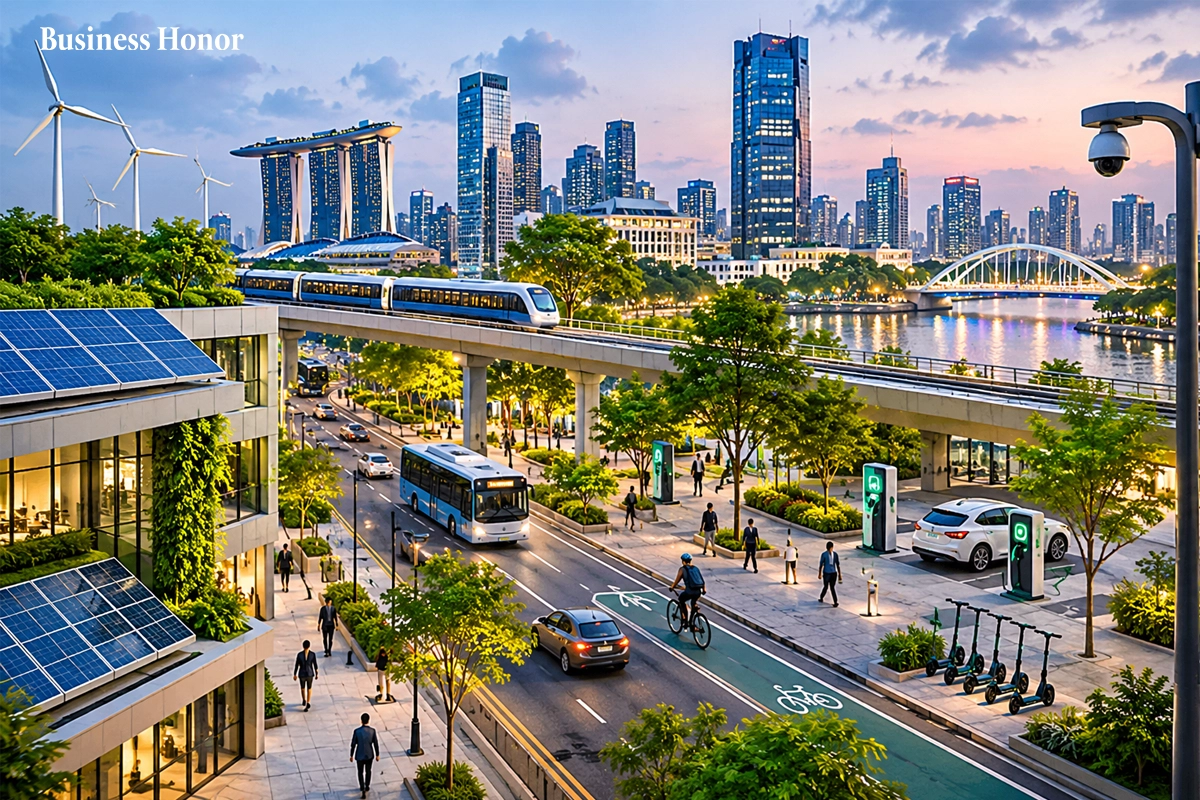
With the advent of smart infrastructure, cities are now using advanced technologies for managing transportation, energy, water, waste, and public services. Governments are making investments in digital networks, automated systems, renewable energy, and information technology in order to enhance the efficiency of urban services. In addition to that, such technologies are also playing an important role in addressing the issues faced by cities with regard to population growth, climate change, and increasing demands for public services.
10 Innovative Smart Infrastructure Projects Transforming Cities Worldwide are showing how countries are integrating engineering and digital technology in order to create more connected and sustainable cities through Advanced Infrastructure Development.
Projects in this list are categorized depending on the technology used, infrastructure design, sustainability, and impact on urbanization. It is not a global ranking of projects but an indication of some of the most outstanding projects.
-
Punggol Digital District – Singapore
Punggol Digital District is one of the key smart infrastructure developments in Singapore. Built by JTC Corporation, the 50-hectare district hosts business facilities and the Singapore Institute of Technology. The district is geared towards supporting industries such as artificial intelligence, cybersecurity, robotics, and financial technology.
The district features an Open Digital Platform, which links various building and district systems through real-time data exchange. Another feature of the development is the district smart grid, which utilizes solar power and battery storage for energy management.
-
Songdo International Business District – South Korea
The Songdo International Business District of Incheon is one of the best examples of technology-driven urban planning. It has been developed on reclaimed land and incorporates connectivity, energy management, transportation, and waste collection through automation.
Some of the features of Songdo include an underground pneumatic waste collection system where waste from households is carried through pipelines to the processing centers. Other technologies used in the city include connected building systems, district heating and cooling, and resource management. The International Telecommunication Union has recorded the use of AI and IoT in Songdo.
-
Masdar City – United Arab Emirates
Abu Dhabi’s Masdar City is a sustainable city that has been established based on clean technology, renewable energy sources, and efficient means of transportation. The project combines residential units, commercial facilities, research centers, and open public spaces.
The infrastructure of the city involves the generation of solar energy and sustainable transportation options. Masdar City has also created its own Personal Rapid Transit system that utilizes electric pods for transportation within the city.
-
EnergyLab Nordhavn – Denmark
EnergyLab Nordhavn was an intelligent energy concept created in Copenhagen from 2015 to 2019. The concept involved using the Nordhavn area as a living lab to show how electricity, heat, energy-efficient buildings, and electric transportation can be integrated.
The concept focused on energy systems that would be capable of adapting to changing needs and making the most out of existing resources. It involved research institutions, utilities, technology firms, and the City of Copenhagen.
-
GIFT City – India
Gujarat International Finance Tec-City, often referred to as GIFT City, is India's first operational greenfield smart city project. Located between Ahmedabad and Gandhinagar, GIFT City incorporates elements of financial services infrastructure along with urban utilities.
Some of its infrastructure elements include underground utility tunnels, automatic waste collection systems, smart water systems, and district cooling systems. There is also a central command and control center for managing utilities and incidents.
-
Barcelona Smart City Infrastructure – Spain
Barcelona has implemented a number of smart infrastructure systems that help it provide better services and manage resources in the city. The Sentilo system in Barcelona gathers data from sensors installed in the city for monitoring parameters like air quality, noise, water, and traffic.
Other systems implemented by Barcelona include smart street lighting, digital traffic management, and water monitoring through sensors. These systems enable the local government to gather knowledge about the situation in the city and manage its services using real-time information.
-
Kashiwa-no-ha Smart City – Japan
The Kashiwa-no-ha Smart City is a Japanese project that brings together urban planning and energy management, as well as environmental planning. One of its most famous constructions is the Kashiwa-no-ha Smart Centre, which keeps track of electricity, water, and gas usage.
The energy management system allows for the exchange of electricity between buildings and employs battery storage to regulate demand. The project also pays attention to public spaces, transportation, and sustainable urban living.
-
Business Bay District Cooling – United Arab Emirates
The district cooling network of Business Bay in Dubai is an essential example of modern infrastructure construction in the Middle East region. The network provides chilled water to buildings via a centralized network, and not through individual cooling networks in each building.
The Emirates Central Cooling Systems Corporation, otherwise known as Empower, runs large district cooling plants in the region. The network provides chilled water to residential, commercial, and hospitality buildings. Centralized cooling could enhance energy efficiency through the regulation of cooling production in the district.
-
Expo City Dubai – United Arab Emirates
Expo City Dubai has been able to turn the former Expo 2020 area into an urban district that is based on the principles of sustainability, innovation, and technology. The infrastructure will enable business development, residential construction, and research.
Additionally, the city acts as a test ground for the use of sensors, IoT systems, and digital technologies to conduct experiments in the fields of energy management, urban cooling, and logistics. The sustainability report of 2025 has pilot cases of energy optimization, autonomous logistics, and digital construction monitoring.
-
HafenCity – Germany
HafenCity in Hamburg, Germany, is one of Europe's largest inner-city urban development projects. Built on a former port and industrial area along the River Elbe, the project combines residential buildings, commercial spaces, public transport, educational facilities, and recreational areas.
One of its most important infrastructure features is its flood protection system. Instead of surrounding the entire district with conventional dikes, many buildings and streets are raised on specially constructed platforms known as Warfts. This design helps protect the district during storm surges while maintaining access to the waterfront.
Countries Leading Smart Infrastructure Development
There are several nations that have been utilizing smart infrastructure in various ways. Singapore is focusing on digital connectivity and urban management, whereas South Korea has built connected communities like Songdo. The UAE has been investing in sustainable urban development, district cooling, and renewable energy.
India has also been improving its capabilities by developing projects like GIFT City, which integrates digital monitoring with utility systems. Denmark and Spain are showing how smart energy networks and sensors can enhance urban infrastructure.
The Future of Smart Infrastructure Development
The 10 Innovative Smart Infrastructure Projects in the World provide us with examples of how technology is shaping the future of urbanization. Starting from automated waste removal, smart grids, digital surveillance, and central air conditioning systems, these projects are solving real infrastructure problems.
In the course of further city expansion, Advanced Infrastructure Development would require the use of technologies, efficient management of resources, and good planning. Countries at the forefront of the development of smart infrastructure are giving us an example of how it could be done.











































.webp)


.webp)



Comments
0 Comments