

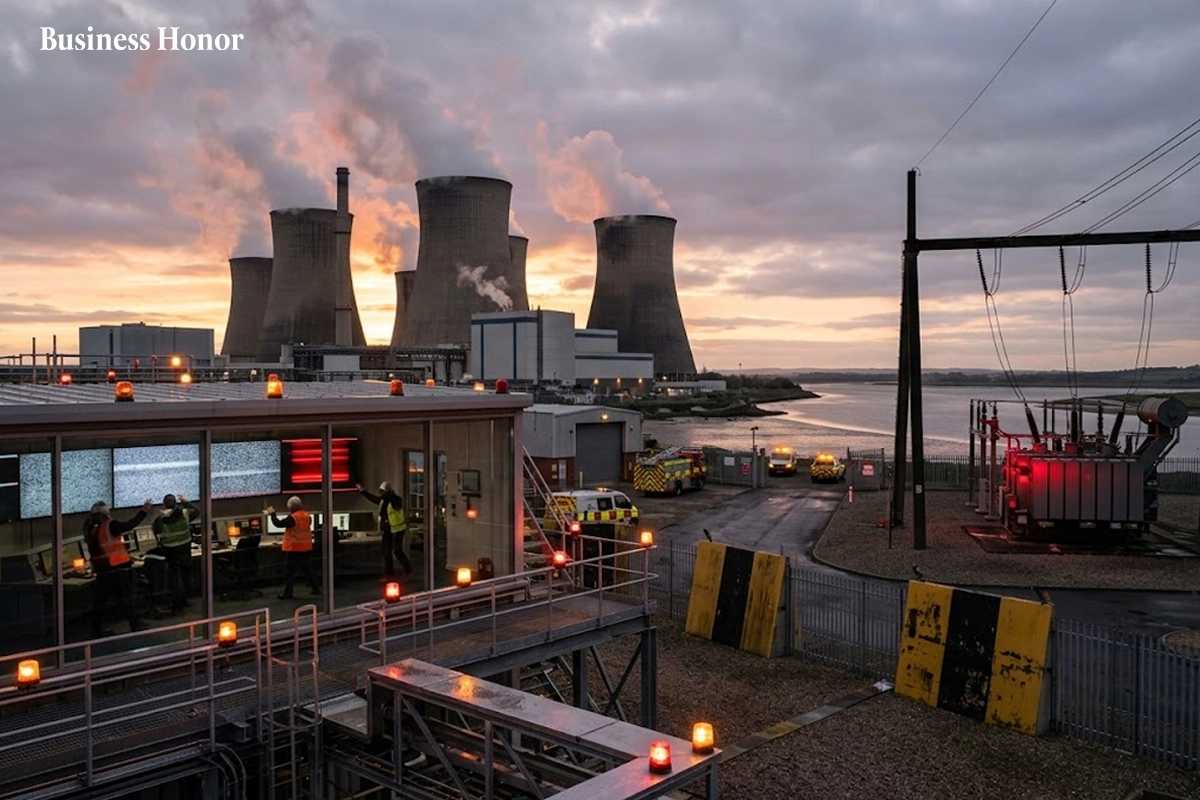
Top Middle East Cybersecurity Companies will spend 2027 under more pressure than ever. The UAE's head of cybersecurity says the country faces 90,000 to 200,000 breach attempts every day. As regional tensions increased in early 2026, according to the annual report of Help AG, UAE Cybersecurity Council noted the rise in that number up to the 500,000 to 700,000 range per day.
Before, security was part of the IT budget. Now security is an item on the risk register. And it is also directly asked about by the board. Gulf buyers evaluate the vendors based on the location of their data center and speed of delivery of the results. Nobody Agrees How Big This Market Is
Analysts agree the market is growing. They disagree on its size. Mordor Intelligence values the Middle East market at $20.55 billion in 2025 and $46.39 billion by 2031. Whereas MarketsandMarkets is prudent, with $18.56 billion in 2026 increasing to $29.39 billion in 2031, Polaris Market Research bases its calculations on $16.78 billion in 2025. The difference is most likely a result of what each organization considers to be cybersecurity, so always quote just one figure.
Spending data is steadier. Arabian Business reported that Grand View Research expects Gulf spending to pass AED 120 billion by 2030, more than double the 2024 level. The UAE and Saudi Arabia make up over 60 percent of it.
Laws Are Driving Demand
The Gulf shows how closely law and spending move together.
For UAE, Personal Data Protection in the UAE is governed under Federal Decree-Law No. 45 of 2021 while Federal Decree-Law No. 34 of 2021 governs Cyber Crimes in the UAE. These have come into force in January 2022. While Saudi Arabia has a Personal Data Protection Law under the auspices of SDAIA, National Cybersecurity Authority provides its essential cybersecurity controls in addition to this. In 2025, the NCA has provided control for non-critical infrastructure businesses
That last step matters. The pressure to comply is moving down from ministries and utilities to ordinary mid-sized firms that never had to show a regulator their security setup. Who will they call? A global brand, or one of the cybersecurity firms in the Middle East that already knows the paperwork?
What a Breach Costs
IBM's 2026 Cost of a Data Breach Report puts the average Middle East breach at $8 million. That is a rise after an 18 percent fall in 2025. Financial services and technology firms paid the most, at $10.67 million each. AI-enabled attacks sat behind 26 percent of malicious breaches, and firms that used AI and automation widely paid over $3 million less per incident.
IBM's regional chief, Saad Toma, told reporters
That cheap attacks and costly clean-ups are "fundamentally changing the economics of cyber risk."
Weak identity controls pushed costs up the most. Excessive privileges and mismanaged keys topped IBM's list. That is why identity runs through the strategies of so many cyber defense companies in the Middle East, including several profiled below.
The Ten Companies to Watch in 2027
Here are ten cybersecurity companies in the Middle East worth following. Some are state-backed. Some belong to telecom groups. Others bring global technology into Gulf networks. Together they cover most of what buyers shortlist.
Sovereign Leaders and UAE Cybersecurity Providers
- CPX (Abu Dhabi, UAE)
Core focus: Sovereign cyber defence, critical infrastructure protection and managed services.
Why to watch in 2027: CPX is a G42 company founded in 2022, and it has grown quickly. It emerges as the first company in Business Honor's Top Middle East Cybersecurity Companies to Watch in 2027, and the numbers show why. The Arabian Post reports about 600 specialists and more than 200 customers. A 2025 deal for exposure-management firm spiderSilk added AI-led detection tools. The bigger story is the UAE Cyber Factory, a joint project with the national Council to build and produce cybersecurity tools inside the country. CEO Hadi Anwar called it "a major step toward a sovereign, future-ready cybersecurity ecosystem". If the UAE wants home-grown defence, CPX is the obvious supplier.
- Sirar by stc (Riyadh, Saudi Arabia)
Core focus: Managed detection and response, cloud security and identity management.
Why to watch in 2027: Sirar is the cybersecurity arm of stc group. IDC named it a Leader in its 2026 MarketScape for Middle East managed security services. Its threat intelligence comes from the telecom network itself, which suits large national programmes where security has to grow with the project. It has also signed an agreement with SAMI-AEC to localize cybersecurity products and services in the Kingdom.
- Help AG (Dubai, UAE)
Core focus: Managed security services, cloud protection and incident response.
Why to watch in 2027: Help AG is e&'s cybersecurity arm. It has worked in the region since 2004 and runs security operations centres in Dubai and Riyadh. Those centres give it unusually good data. Its 2026 report counted more than 371,000 DDoS attacks in 2025 and found attacks finishing 65 percent faster in early 2026. Its own analysts now run over 145 automated response scenarios.
Acting CEO Dr Aleksandar Valjarevic says cybersecurity "must now operate continuously, at machine speed."
Regional Champions
- SITE (Riyadh, Saudi Arabia)
Core focus: Secure-by-design digital platforms and national cybersecurity capability.
Why to watch in 2027: SITE was set up in 2017 and is wholly owned by the Public Investment Fund. It is building a cybersecurity business through partnerships. Its joint venture with Korea's AhnLab gives SITE 75 percent of a company that localizes AhnLab's cloud and AI-based security platform for Saudi clients. The partners also plan to take generative AI security services across the wider region later. It is a clear sign of how Saudi state firms import technology while keeping control at home.
- CyberKnight (Dubai, UAE)
Core focus: Zero Trust architecture, identity-threat detection and security automation.
Why to watch in 2027: CyberKnight sells advice as much as products. It has run a Saudi legal entity since 2020 and builds its pitch around a Zero Trust framework. A partnership with ON2IT now brings Zero Trust as a Service to the region. That lines up with IBM's finding that identity gaps drive the highest breach costs.
- Spire Solutions (Riyadh and Dubai)
Core focus: Enterprise network defence, cyber threat intelligence and threat hunting.
Why to watch in 2027: Spire supplies tools to energy, government and banking clients across the Gulf. These are the sectors where breaches cost the most. It works with threat-intelligence vendors such as Group-IB, which lets it bring outside intelligence to local customers. Heavy industry needs that kind of proactive hunting.
Integrators and Industrial Specialists
- Gulf Business Machines (Dubai, UAE)
Core focus: Enterprise infrastructure security, hybrid cloud protection and cyber resilience.
Why to watch in 2027: Gulf Business Machines is a big integrator with years of experience in the GCC market. It offers GBM Shield solutions which include penetration testing, red teaming, threat hunting, and incident response services. GBM received CREST and DESC accreditations in penetration testing and incident response in 2024. According to H.E. Amer Sharaf, the DESC's Cyber chief, companies should collaborate with accredited providers. GBM has acquired a majority share in the Dubai company Coordinates. No competitors come close to GBM's size and accreditation.
- DTS Solution (Dubai, UAE)
Core focus: Compliance orchestration, adversary simulation and OT/ICS security.
Why to watch in 2027: DTS operates in the area of security which most companies tend to ignore – the industrial systems of energy, power, and manufacturing industries. The price for doing that becomes evident from IBM data of 2025 showing that an IoT and OT environment contributed about SAR 839,000 to the average regional cyber attack damage.
- Advanced Electronics Company (Riyadh, Saudi Arabia)
Core focus: Defence electronics, cybersecurity integration and hardware security.
Why to watch in 2027: AEC is fully owned by SAMI, the state defence group. It builds secure hardware for government communications and national security work. Aramco and AEC have also launched a cybersecurity solution designed and made in Saudi Arabia. Local manufacturing is the thread that ties it to the sovereignty story.
- Bulwark Technologies (Dubai and Riyadh)
Core focus: Specialized value-added distribution, endpoint security and data leakage prevention.
Why to watch in 2027: Bulwark Technologies was incorporated in 1999 and is located in Dubai. As stated by the company's profile in Tahawultech, the vendor represents over 20 security brands and has around 500 partners. The security portfolio includes email security, data classification and SIEM. The distributors such as Bulwark determine the first Gulf vendors of security solutions.
Where the Friction Sits
Talent comes first. Mordor Intelligence's Middle East and Africa analysis flags a skills shortage that pushes service costs up, and IBM's 2025 data shows staff gaps adding roughly SAR 819,000 to the average breach. Suppliers come second. Third-party compromises caused 17 percent of regional breaches in 2025, at close to SAR 30 million each. The third problem is fragmentation. Help AG's report asks for coordinated GCC-wide resilience, yet each state still writes its own rules.
Where the Opportunity Lies
Sovereign cloud, operational technology and AI oversight offer the clearest openings. Only 38 percent of Middle East organisations had formal AI governance policies in 2025, and another 24 percent were still drafting them. Post-quantum planning is also moving from talk to budgets. UAE officials already act on it. Dr Mohamed Al Kuwaiti, who heads the country's cybersecurity effort, put the stance in one line: "We anticipate threats - we do not wait for them".
Buyers face an awkward choice. Does a bank pay extra for a sovereign provider that keeps regulators calm, or for a global product that may be technically stronger?
Business Honor examines that The Gulf sees cybersecurity as part of national strategy, and the market favors businesses which can demonstrate results. All ten firms listed above are very different in terms of size and nationality, but they all have one thing in common: they believe that sovereignty, automation, and identity will define the coming years. Will they continue to dominate, or will the next generation come from those who work underneath them?
FAQs
What makes the Top Middle East Cybersecurity Companies essential for regional enterprises in 2027?
Top Middle East Cybersecurity Companies deliver localized threat intelligence, sovereign data residency compliance, and dedicated protection for critical infrastructure aligned with GCC mandates like KSA PDPL and UAE DESC standards.
How do UAE Cybersecurity Providers help businesses maintain compliance with local laws?
Leading UAE Cybersecurity Providers offer localized data storage, onshore Security Operations Centers (SOCs), and incident reporting frameworks built directly around Federal Decree-Law No. 45 and DESC requirements.
Why is identity protection a top priority for cybersecurity firms in the Middle East?
Identity misconfigurations and excessive user privileges are primary drivers of enterprise breach costs in the Middle East. Zero Trust architectures and identity-threat detection (ITDR) mitigate these high-cost risks.
What role do cybersecurity companies in the Middle East play in protecting Operational Technology (OT)?
Firms like DTS Solution and SAMI AEC provide specialized hardware defense, industrial control system (ICS) protection, and adversary simulations to shield power grids, refineries, and smart city infrastructure from physical and digital disruptions.
How are AI and automation shaping the future of cyber defense in the GCC?
AI-driven Security Operations Centers allow regional defense providers to run automated response scenarios at machine speed, significantly reducing incident remediation timelines and lowering breach costs.







































.webp)



.webp)



Comments
0 Comments