
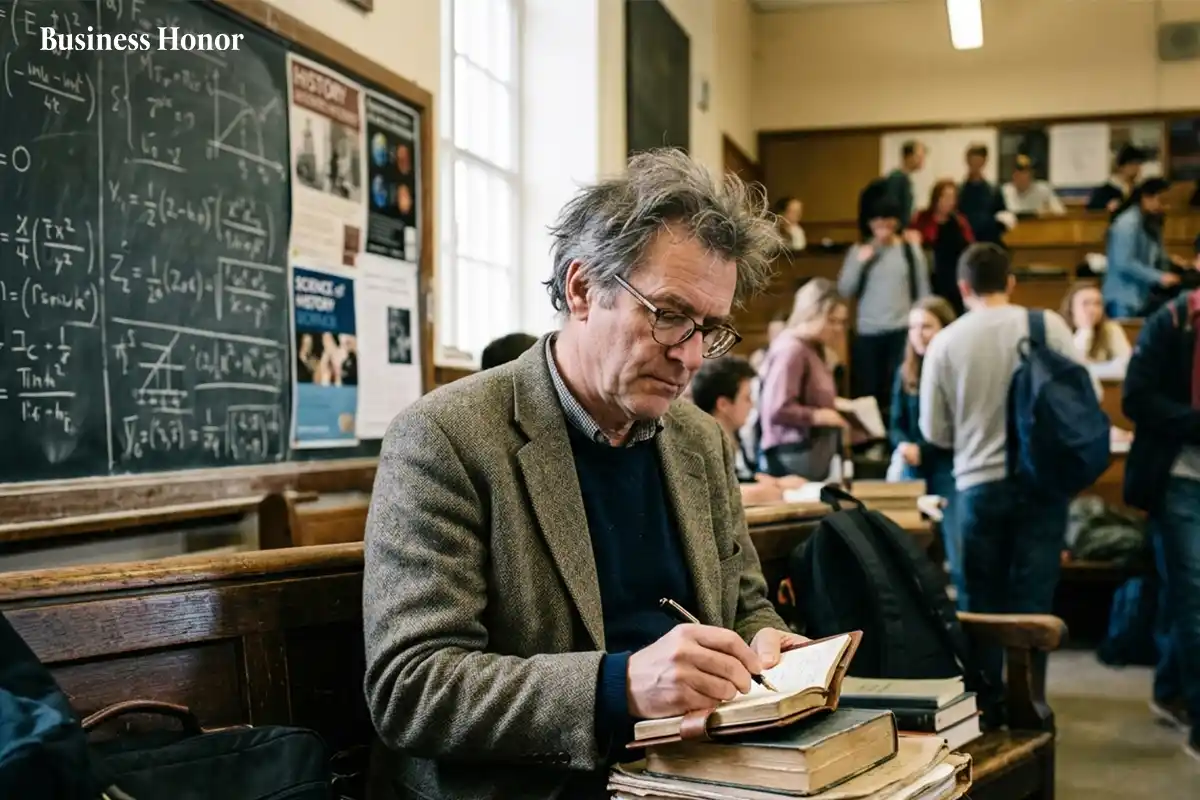
The marks at school are generally considered an early indicator of someone's intelligence, yet history suggests a different picture. There were people who are considered some of the greatest geniuses of the past who had problems in school, hated the traditional learning environment, or even left school without completing the program. These examples prove that school performance does not completely indicate one's potential.
Moreover, there have been several examples of famous failures in school that later turned out to have been overstated. Albert Einstein never failed in math, and Winston Churchill was not just a bad student. It is important to remember that their true experiences are more valuable.
Here are some brilliant minds whose education included genuine difficulties, limited schooling, or academic setbacks.
Thomas Edison: A Learner outside the Classroom
Thomas Edison has frequently been referred to as one of the greatest school failures in history. The widely publicized version is that Edison was regarded by a teacher as being unfit to learn, and his mother had him taken out of school. Historical research suggests that this version was embellished over time.
The facts are that Edison had very little formal education and was homeschooled for many years by his mother, Nancy Edison. Edison showed great interest in science and experimentation from a young age.
Edison spent a lot of time studying, experimenting, and teaching himself. His curiosity eventually resulted in him inventing thousands of things. Edison's case is one of the most well-known Academic Struggle Stories, but this does not mean that formal education is not necessary.
Henry Ford: More Interested in Machines
Henry Ford was not very excited about academics. Biographies portray Ford as a poor student, especially when it came to reading and spelling.
Ford dropped out of school when he was around 15 years old and gained hands-on mechanical skills. Henry had always been interested in machines since childhood and eventually became an engineer and machinist.
This practical interest thus formed the basis of his professional life. Henry Ford went on to establish Ford Motor Company and made cars more affordable through mass production.
His case demonstrates how academic and practical abilities can be different. His story is often cited as one of the cases of Successful Academic Failures.
Richard Branson: Struggling With Dyslexia
Richard Branson has talked extensively about how he had trouble learning at school due to dyslexia. At 15 years old, Branson quit school and started exploring various business ventures at a young age.
Student was one of his first business ventures, in which he published a magazine when he was in his teens. Later on, he diversified into music, airlines, telecommunications, and many more ventures under the brand name Virgin.
It is worth noting that Branson's case becomes even more important in the context of Brilliant Minds Struggling in conventional classrooms. Dyslexia made it difficult for Branson to perform well in school, but it did not stop him from becoming an entrepreneur.
Alexander Graham Bell: An Unremarkable School Record
Alexander Graham Bell, who is famous for being a pioneer of the telephone, was not an exemplary academic performer when he was young.
Bell enrolled at the Royal High School of Edinburgh but had to leave at age 15. He was not a stellar student, yet his fascination lay in science and communication.
Bell went on to become a renowned figure in telecommunications, as well as in speech, hearing, and education.
This is an example showing how average academic performance in school does not have to be a predictor of one's future success.
Charles Darwin: Finding His Real Interest
Education for Charles Darwin was a rocky road. Darwin started to study medicine at the University of Edinburgh but showed no inclination toward being a physician. He disliked surgery and eventually quit medicine.
While at Cambridge University, Darwin found his focus shifting increasingly toward natural history. Darwin devoted much time to studying various plants, animals, and insects.
Eventually, Darwin became one of the greatest naturalists in history. His theory of natural selection changed biology forever.
This story is significant to Academic Struggle Stories, as Darwin was not someone who could not learn but simply had different intellectual passions from what his family wanted him to pursue.
Albert Einstein: The Famous Academic Myth
Albert Einstein is likely the most renowned individual wrongly labeled as an academic failure in school.
The fact that Einstein had problems with mathematics is a misconception. Einstein was actually gifted in mathematics and physics. But he was unhappy with the strict way in which they were taught at the Munich school and quit at age 15.
However, Einstein did fail the first exam he took to enter the Swiss Federal Polytechnic in Zurich. Nonetheless, he was very good at mathematics and physics and finally passed the examination after studying in Aarau.
In this respect, Einstein cannot literally be called a Successful Academic Failure. His case illustrates how easily myths related to education can become accepted by people.
Winston Churchill: More Complicated Than the Myth
Although Winston Churchill is often portrayed as a bad student, that characterization does not tell the whole truth.
He had difficulties in areas like mathematics and classical languages and was usually one of the worst students in the classes he did not like. Nevertheless, he excelled in English and history.
The situation greatly changed when he went to study at the Royal Military College at Sandhurst and graduated near the top of his class.
In other words, the case of Winston Churchill demonstrates why the characterization Successful Academic Failures requires some background information.
What These Stories Really Teach Us
Each of these geniuses had a completely different approach to education. While some found difficulty in specific disciplines, some could not stand formal educational institutions, some were deprived of formal education, while others left school too soon.
Their examples must not be taken to mean that formal education is not important. On the contrary, these stories tell us that genius comes in many forms and that poor academic results may not determine people's lives later.
Business Honor believes that Academic Struggle Stories, Famous School Dropouts, Successful Academic Failures, and Brilliant Minds Struggling all point to one simple fact: a bad grade may be part of the story, but it is never the conclusion.









































.webp)

.webp)



.webp)



Comments
0 Comments