
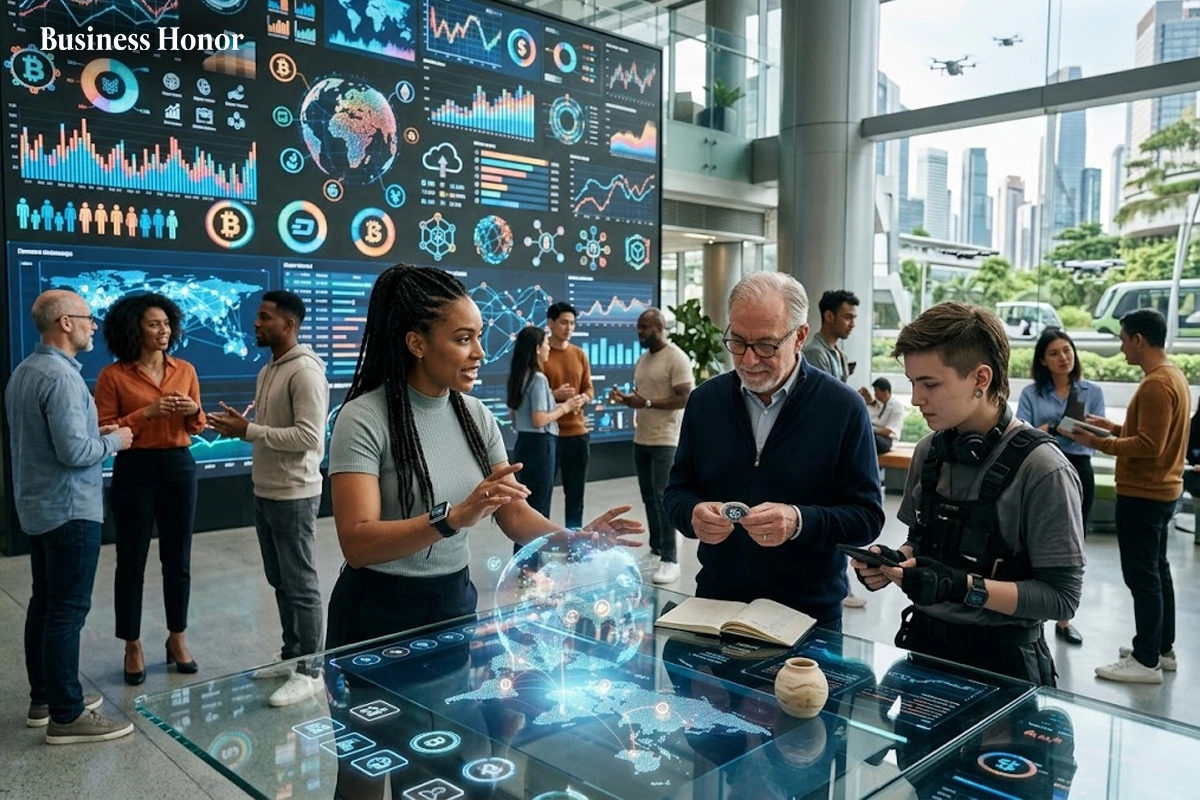
Money has been an essential part of the exchange of goods and creation of wealth for ages. However, due to the tremendous development in the realms of artificial intelligence, robotics, automation, and digital money, the following question is being asked these days: Will Money Still Matter in 2036?
The debate gained attention after Elon Musk made a striking prediction during a 2026 interview with The Economist. Discussing AI and robotics, Musk said:
“Money won’t matter in 2036.” — Elon Musk
His point is that very advanced forms of AI and robots can eventually create more than what humans will ever need, leading to an economy of abundance rather than scarcity.
While Musk’s statement is a prediction and not a forecast by any means, it brings up some significant questions regarding the future.
Elon Musk’s Perspective on Money in 2036
The point of Elon Musk’s view on money is the connection between money and scarcity. Humans need money since goods and services are scarce and have a price. Should artificial intelligence (AI) and robotic systems begin to generate food, transportation, dwellings, entertainment, and other services extremely cheaply, the economic function of money will be altered.
His broader vision suggests that AI could make many traditional jobs optional. Instead of work as a means of acquiring money, humanity may find itself in an extremely productive environment through the development of technologies.
This will require huge technological breakthroughs in robotics, energy, computing, infrastructure, and AI.
The Future of Work in the Economy of Artificial Intelligence
One of the most important factors that will define the future role of money is the future of work.
Artificial intelligence is progressing from mere automation to becoming a powerful tool that is capable of analyzing data, producing software, conducting research, and performing other digital tasks.
In the next decade, automation might seriously affect administrative, customer support, programming, financial analysis, marketing, and research.
Nevertheless, human labor will not become outdated. Most jobs will probably transform but will not disappear. People will concentrate on strategic thinking, creativity, management, social interaction, and control over artificial intelligence.
Income distribution becomes the main problem. As the share of the economy created by machines rises, people will have to think about who will own those machines and how their economic benefit will be distributed.
Money in 2036 – What It Could Be
Despite the decrease in the importance of physical money, money in 2036 may still be crucial.
Consumers are now switching to cards, mobile wallets, instant payments, and online banking. The next step is the introduction of digital, programmable, and automated money.
Central banks and financial institutions are also looking into such innovations as central bank digital currencies, stable coins, tokenized deposits, and other digital payment solutions.
Thus, the future of money does not need to mean the disappearance of money. Rather, money is becoming intelligent, digital, and automated.
Digital Currency and Future Finance
The concept of digital currency may have an important role to play within the financial system in the year 2036.
The central banks are evaluating digital currencies, whereas private firms are coming up with stablecoins and payment innovations. Tokenization will also ensure that financial products are digitally tokenized and can be transferred.
These changes will help to automate transactions and integrate the financial sector better with digital platforms.
An important long tail trend that we need to look out for would be the effect of digital currency on global payments by 2036.
Money and AI: The Moment Machines Start Making Transactions
The link between AI and money might take on greater significance as AI agents are able to act on behalf of individuals and companies.
An AI agent might be able to do things like price-compare, handle subscriptions, buy products, and perform other transactions as per their approval. This would lead to a shift in interaction with financial products.
Instead of looking for products and conducting transactions on one’s own, one can issue instructions to AI agents to carry out transactions under certain restrictions.
The next longtail trend in the area of money is the management of one's finances and digital payments by AI agents.
This will make money invisible in day-to-day activities.
Could Money Really Be Dispensed With?
The prophecy of Musk relies upon a massive degree of technological abundance. When AI and robotics are capable of creating almost everything needed by humans at an incredibly low cost, money might lose its significance with regard to necessities.
Nevertheless, scarcity might never vanish.
Land, energy, natural resources, infrastructure, desirable locations, and human attention might continue to be scarce. Although robots might be able to build houses, land will be scarce.
Another critical aspect to be considered is ownership. The fact that some entities might control advanced AI technologies, robotics, computing infrastructure, or energy sources may mean that technological abundance does not necessarily mean economic equality.
Wealth Could Be Defined Differently
The definition of wealth could also be different.
Wealth is currently considered to be synonymous with money, possessions, investments, and businesses. But in an AI economy, computing power, energy, data, intellectual property, infrastructure, and AI technology could all gain more and more importance.
This would take the discussion away from the amount of money one possesses towards the amount of resources that one has access to.
Even in an automated economy, experiences, interpersonal connections, prime locations, and other rare resources could still be considered valuable.
Major Challenges for an AI-Based Economy
The following are some of the major challenges in moving toward an AI-based economy:
Job Displacement: Automation may disrupt jobs before people can adjust to the changes.
Wealth Concentration: Access to sophisticated AI could lead to the concentration of wealth within a few organizations and individuals.
Economic Instability: The move away from conventional employment would pose challenges for taxing and welfare systems.
Resource Demand: AI would require a lot of computing resources, energy, infrastructure, and materials.
Governance: AI would present challenges related to privacy, cybersecurity, regulations, and accountability.
Will Money Still Matter in 2036?
The most realistic response would be that money will most likely remain relevant in 2036, though its significance may have changed dramatically.
AI and robots may lower the cost of production, electronic payments may dominate the scene, and AI agents may handle an increasingly larger proportion of monetary transactions. Tokenization and cryptocurrencies may also become more commonplace within the financial system.
This prediction by Musk is not the most realistic scenario but rather one extreme scenario. What is more likely to happen is the evolution process during which some products will become significantly cheaper while others will remain valuable because of scarcity.
Conclusion
The issue of whether money will still matter in 2036 comes down to a discussion about scarcity, technology, work, and value.
AI can affect the future of work in a revolutionary way, while digital currency can change the nature of financial transactions. Additionally, the connection between AI and money can be enhanced as self-governing systems start making payments and other financial operations.
It is doubtful that money will cease to exist by 2036; rather, it can become increasingly digitalized, programmable, automated, and invisible in everyday transactions.
Elon Musk's assertion provides a stimulating perspective on what an economy based on abundance can be like. The realization of such a scenario would depend not only on AI and robotics but also on many other factors. Business Honor continues to examine emerging technologies, economic trends, and business developments that could shape the future of wealth, work, and value.































.webp)

.webp)



.webp)



Comments
0 Comments