
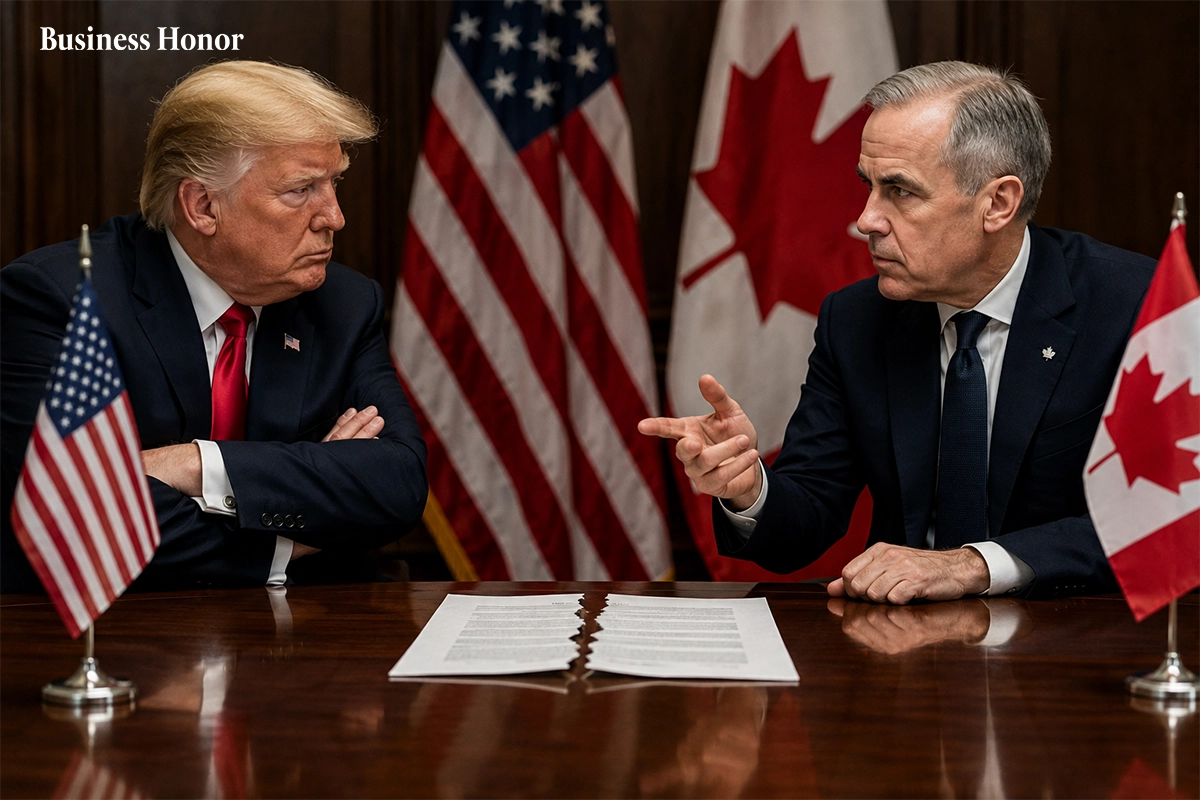
Trump Canada tariffs talks have collapsed after Mark Carney rejected key U.S. demands, pushing Canada and the United States toward a wider trade war.
|
The US President Trump Canada tariffs dispute has erupted into a wider trade crisis after U.S.-Canada negotiations collapsed just hours before new tariffs were set to take effect.
Prime Minister Mark Carney pulled Canadian negotiators out of Washington after weeks of talks failed to resolve major disputes over cars, steel, trade policy, and Canadian sovereignty.
U.S. officials, represented by the Office of the United States Trade Representative, said Washington had offered Canada what it called its best trade deal with any country. Canadian officials saw the proposal very differently, arguing that Ottawa would have to surrender too much in return for tariff relief.
The breakdown now puts the U.S.-Canada trade war on a more dangerous path. President Donald Trump has threatened to raise tariffs on Canadian cars, trucks, auto parts, and steel to 50%. Canada is preparing its own response through official channels like the Government of Canada.
Autos were among the biggest sticking points. U.S. Commerce Secretary Howard Lutnick pushed for tougher treatment of Canadian vehicles and heavy trucks, while Ottawa demanded better terms for its auto industry.
The dispute went beyond tariffs. Washington wanted Canada to align its tariffs on goods from other countries with U.S. policy, particularly for steel. Canada rejected the demand as it works to build new trade relationships outside the United States.
Ottawa also wanted guarantees that any agreement would provide lasting tariff certainty. Washington refused to give up its ability to change tariff policy later.
Then another sensitive issue entered the final hours: Canada's rules protecting Canadian and French-language content on streaming platforms like Netflix. The disagreement added fresh pressure to already fragile Canada trade negotiations.
The proposed return of the Keystone XL pipeline also failed to save the deal. Canada had considered supporting the project, but the idea disappeared as the talks fell apart.
Carney has rejected the idea of Canada being treated as a subordinate partner. Trump, meanwhile, argues that the United States holds the stronger economic position.
The collapse shows that Trump Canada tariffs are now about more than import costs. They have become a test of industrial policy, trade independence, and national sovereignty.
For companies, the immediate problem is uncertainty. Higher tariffs could increase costs, disrupt North American supply chains, and pressure industries built around cross-border production.
Business Honor examines that the next move is Ottawa's. If Canada retaliation tariffs follow, a failed trade deal could quickly become a prolonged economic confrontation forcing both countries to decide how much they are willing to lose to prove who holds the stronger hand.



































.webp)

.webp)



.webp)



Comments
0 Comments