
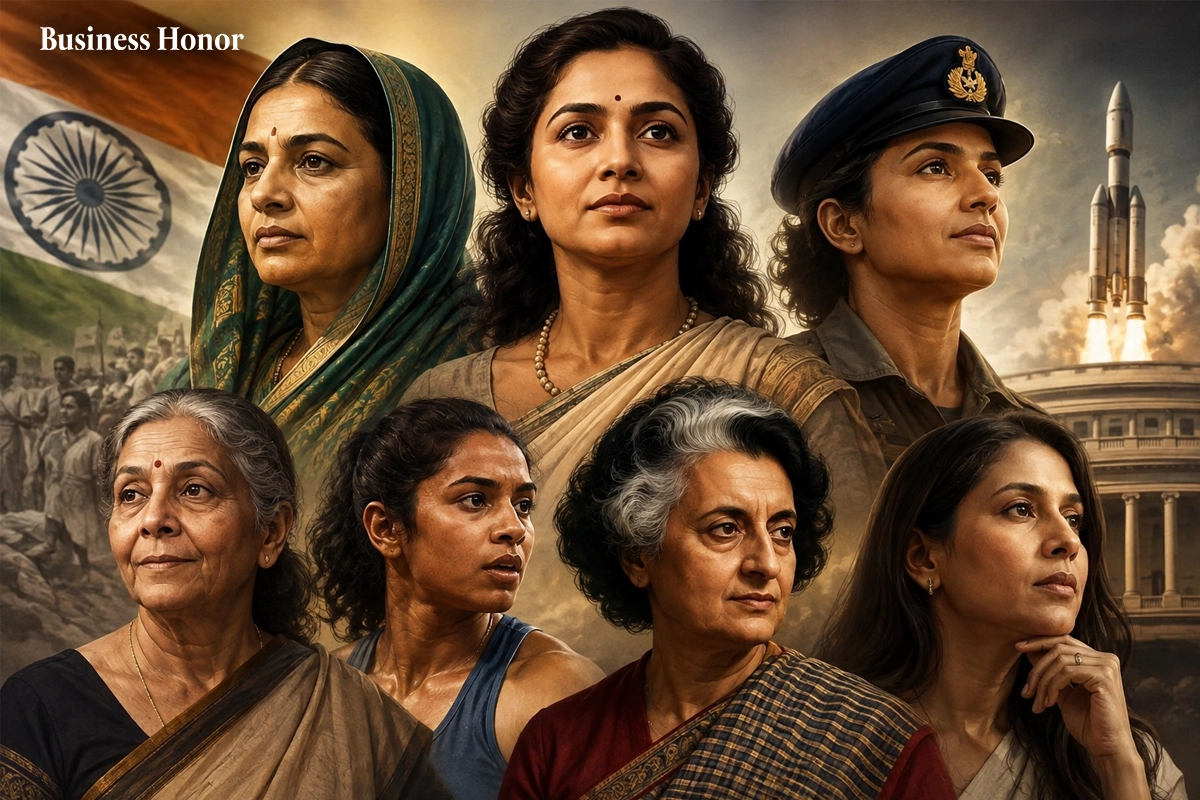
When looking back at the Indian women who made history, one thing becomes instantly clear. Progress was never handed over freely. It was fought for, line by line, through sheer grit and stubborn determination.
Every barrier broken by a female leader changed the rules of society for everyone who came next. Long before gender equality became a standard talking point in boardroom meetings or global conferences, courageous women were quietly taking apart unfair systems. Their victories were more than just personal triumphs. They created practical blueprints for national freedom, better laws, and a fairer society.
How do the tough battles fought by earlier generations shape the way modern leaders handle power and overcome bias today?
To understand where female leadership is heading today, we have to look back at the people who laid the groundwork. The backbone of modern India from schools and laws to police forces and global culture was shaped by inspiring Indian women who simply refused to sit back and accept old restrictions.
The Foundations of Reform: Education and Social Emancipation
Real change started in simple classrooms, often built despite intense anger from the public. Back in the mid-nineteenth century, teaching girls was seen as a dangerous idea that could ruin social order. Pushing past that belief took a lot more than smart ideas. It took real physical courage.
Savitribai Phule: Pioneer of Women’s Education
She opened India's first school for girls at Bhide Wada in Pune in 1848, alongside her husband Jyotirao Phule. Even though people in her community turned against her, she pushed hard for school reforms, set up safe homes for women in need, and spent her whole life fighting against caste bias and unfair treatment of women.
Opening that first school did something far bigger than teaching girls how to read. By giving young women a seat in a classroom, Savitribai Phule directly challenged deep caste and gender lines. She proved that learning is the ultimate tool for taking control of your own life. Today, as documented by the Ministry of Education, every time we see more women graduating or working in science, we can trace that line right back to those brave early days in Maharashtra.
Framing the Republic: Governance, Law, and Public Administration
As the country fought for independence and began rebuilding itself, women who changed India took on vital roles in writing laws and running the government. Moving from political activists to practical leaders, these first women in India proved that female perspectives were crucial for building a strong country.
Sarojini Naidu: First Indian Woman Governor
She became the Governor of the United Provinces (known today as Uttar Pradesh) in 1947, making her the first woman to hold a governor post in independent India. Known around the world as the "Nightingale of India" for her poetry, she was also a key political strategist during the freedom struggle and served as President of the Indian National Congress in 1925. Details on her historic executive role are maintained by the Raj Bhavan Uttar Pradesh.
Sucheta Kriplani: India’s First Woman Chief Minister
She led the state government of Uttar Pradesh from 1963 to 1967. A fearless figure during the Quit India Movement and an active member of the team that wrote India's Constitution, she helped guide state administration through very chaotic post-independence years. Her contributions to the constitutional debates are officially archived at the Constituent Assembly Debates Archive (Parliament of India).
What does it take to run massive government offices during times when men held almost all the authority?
The work of these political leaders shows clear thinking and sharp focus. Handling large populations, thin budgets, and post-partition problems required straightforward action. They set a firm example: women were more than ready to run government cabinets, guide local economies, and keep order during tough historical moments.
Breaking Institutional Glass Ceilings: Public Order and the Presidency
In the decades after independence, the goal shifted toward stepping into tough, male-dominated spaces like law enforcement, public safety, and the highest constitutional offices.
Kiran Bedi: India’s First Woman IPS Officer
She joined the Indian Police Service (Ministry of Home Affairs) in 1972 as its very first female officer. She earned global respect for making deep, humane changes inside Tihar Jail (Delhi Prisons Department), introducing police programs that worked directly with local communities, and bringing strict discipline to police work.
Pratibha Patil: India’s First Woman President
She took the oath as the 12th President of India, serving from 2007 to 2012. Before taking on the presidency, she served as Governor of Rajasthan and held several minister posts over a long career in public service. Her official presidential record is documented on the Rashtrapati Bhavan Official Website.
Getting into a restricted role is only the beginning. What you do once you are inside is what actually matters. By fixing how Tihar Jail was run under the Prisons Act, 1894, Kiran Bedi turned prison work away from harsh punishment and toward helping people restart their lives. In the same way, Pratibha Patil becoming president sent a clear message home and abroad about the equal standing of women in Indian leadership under the Constitution of India.
Can real change ever happen in old institutions if we never bring in fresh perspectives to question how things are done?
Global Representation and Cultural Impact
Beyond passing laws and managing state offices, cultural presence matters a great deal. It changes how a nation sees itself and how the rest of the world looks at it. Figures who step onto the global stage widen possibilities for everyone watching back home.
Sushmita Sen: India’s First Miss Universe
She won the Miss Universe title in 1994 at just 18 years old, bringing national attention to global stages. She went on to build a distinct career in Indian movies, always making bold and personal choices both on and off screen.
Winning an international title in the early 1990s lined up with a period of big economic shifts in India. It marked the start of a fresh era where young Indian women began competing and winning in international spaces across entertainment, business, and art.
The Modern Legacy: From Historical Precedent to Contemporary Power
The line running from nineteenth-century teachers to modern presidents shows an obvious pattern. Each generation stands on the ground cleared by the people before them. The hard work of early pioneers made it normal for women to step into public life, making future wins expected rather than surprising.
Look around today and you see this history everywhere. From people running large companies to scientists leading space research at the Indian Space Research Organisation (ISRO), female voices are central to getting work done. However, the most important lesson from all these stories is simple: progress does not keep moving on its own; it takes ongoing effort to protect and build on it.
How will today’s leaders use their positions to clean up the remaining barriers for the people coming up next?
Business Honor examines that the journey of these early figures gives us real inspiration, but it is also a reminder of our responsibilities. They showed us that true leadership is not about holding onto a fancy job title. It is about leaving behind real changes and opening doors for everyone coming behind you.
FAQ:
Who were the first women in India to break major societal and political barriers?
Savitribai Phule in education, Sarojini Naidu in state governance, and Sucheta Kriplani in executive leadership were among the earliest women to break through heavy social barriers after the nineteenth century.
How did inspiring Indian women impact the education system during colonial rule?
Early pioneers like Savitribai Phule built India's first dedicated schools for young girls in 1848, bringing structure to teaching and breaking down old rules that kept women from learning to read.
Which female leaders shaped the constitutional and administrative framework of independent India?
Leaders like Sucheta Kriplani, who worked directly on the constitutional team before becoming the first female Chief Minister, along with Sarojini Naidu, played direct roles in shaping state policies and early governance.
What role did women who changed India play in modernizing law enforcement and judiciary?
Leaders like Kiran Bedi, serving as the first female IPS officer, updated police work by focusing on community cooperation and building rehabilitation programs inside prison systems.
Why the history of Indian women is pioneers relevant for future leadership development?
Looking closely at these historic figures gives us practical strategies for tackling tough challenges, changing outdated systems, and building balanced teams in modern workplaces.



































.webp)

.webp)




.webp)



Comments
0 Comments