
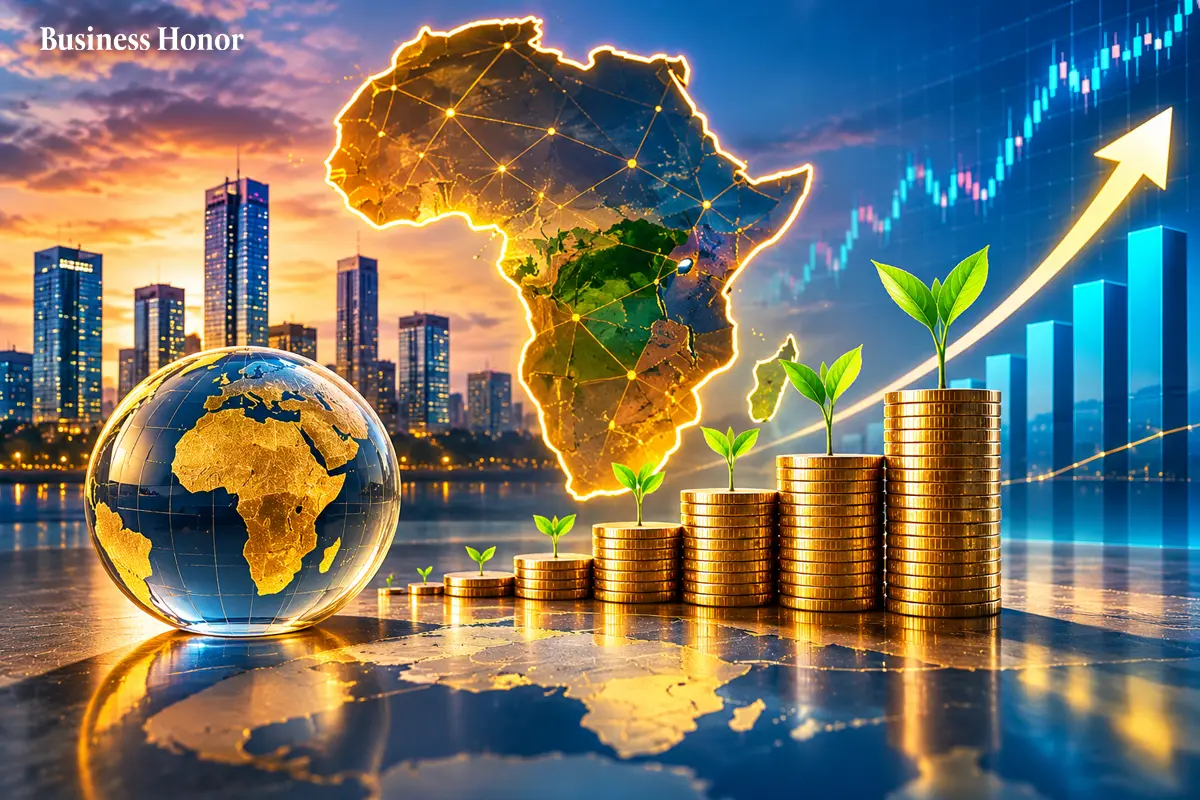
Africa's most influential investment leaders in 2027 are working in a sector that is entering a new phase, as private equity, venture capital, infrastructure finance and sovereign investing draw growing attention. From established markets in South Africa and Nigeria to hubs in Egypt, Kenya and Ghana, capital allocation is playing a larger role in the continent's economic development.
Foreign direct investment shows both the opportunity and the risk. UNCTAD's World Investment Report 2026 puts 2025 inflows at about $70 billion, down from $94 billion in 2024, and analysts note that flows swing on a few megadeals and host countries. That makes the leaders who allocate capital more important.
Who are Africa's most influential investment leaders in 2027? However, Business Honor observes that the response goes far beyond entrepreneurs and financiers. The answer is about development bank CEOs, sovereign and pension fund directors, and private equity and infrastructure experts, whose actions affect industries like financial services, telecommunications, energy, agriculture, and technology.
Africa's Evolving Investment Ecosystem
Investment management in Africa is becoming more locally anchored, more diversified and more selective. Data from the African Private Capital Association (AVCA) shows the shift.
-
Deals held up in 2025. Africa recorded 530 private capital deals, up 8% year on year, and was the only global region to post growth in deal volume. About $5.1 billion was invested.
-
Domestic capital is carrying more weight. Local buyers made up 68% of private capital acquisitions in 2025, with international buyers, led largely by Asian strategic investors, taking the rest.
-
Exits and private debt are growing. There were 81 exits recorded, an increase of 27%, and the volume of deals for private debt increased by 57%.
-
Fundraising is the pressure point. Fundraising declined by 34% to $2.7 billion in 2025, although the number of final closings increased by 28% year on year in Q1 2026.
The first half of 2026 was mixed: deal volume fell 16% to 211 transactions, and venture deals dropped 34% to 102. Venture fundraising moved the other way, with closes of $558 million in the first half, more than all of 2025.
The players are changing too. State investors such as NSIA, MOFI, and the PIC now join development banks, African investment firms such as Helios and DPI, and venture capital firms as new players. They make up a layered investment system where governments’ books, pension funds, and private investors work together.
Africa's Growing Importance in Global Markets
The continent's influence in global markets is growing in terms of resources, demography, and diplomacy, even though its share of global flows remains modest.
-
Capital flows: Inward foreign direct investment (FDI) into Africa was $70 billion in 2025, the third highest inflow since 1990 and around a third above its historical average, while global FDI increased by 6% to $1.6 trillion.
-
Critical resources: Sub-Saharan Africa is home to almost 30% of the world’s known deposits of strategically important metals such as copper, cobalt, lithium, and manganese.
-
Diplomatic representation: The African Union is a full G20 member state since 2023, while South Africa was the G20 chair in 2025.
-
Integration: 50 countries have ratified the AfCFTA, while according to Afreximbank, intra-African trade is expected to grow 10% to $230 billion in 2026.
The gap between weight and share is the opportunity. Africa's share of world trade is below 3%, while African investment is only 4%, according to the head of the AfCFTA. According to UNCTAD, the problem is how to convert strategic investment into industrialization. Leaders who connect African projects to global capital, as the ten profiled below do, sit at that hinge.
Key Investment Sectors Attracting African and Global Capital
UNCTAD points to energy infrastructure and critical minerals as the drivers of recent inflows. AVCA data shows private capital spreading beyond fintech. The table groups the main sectors by what is pulling capital in.
|
Sector |
What is drawing capital |
Evidence |
|
Energy and renewables |
Electrification, solar, wind, hydropower, transmission and distributed energy |
Mission 300 aims to bring power to 300 million people by 2030; the World Bank Group and AfDB have committed nearly $15 billion, and the EIB pledged over EUR 1 billion in March 2026 |
|
Critical minerals |
Copper, cobalt, lithium and processing for batteries and grids |
The IEA says copper drove over 90% of growth in new critical mineral project spending in a decade; greenfield spending rose from $3.5 billion in 2016 to over $7 billion in 2024 |
|
Digital infrastructure and data centres |
Cloud, AI workloads and fibre, with power as the bottleneck |
Africa has under 1% of global data centre capacity despite nearly a fifth of the world's people; installed capacity is expected to triple to about 1.2 GW by 2030 |
|
Infrastructure and logistics |
Ports, airports, transmission and recycled public assets |
NSIA and the World Bank plan power, airport and seaport financing; Africa50 backs asset recycling |
|
Agriculture, industrials and private credit |
Broader sector mix and venture debt as fintech venture slows |
Fintech venture deals fell 33% in Q1 2026 as capital spread to agriculture and industrials; private debt deals rose 57% in 2025 |
What they all have in common is long-dated bankable assets. This suits well those entities mentioned below and explains why many private sector players are developing strategies for credits, climate and infrastructure in addition to their equities business.
10 Influential Investment Leaders to Watch in 2027
Key Leadership Profiles and Company Contributions
1. Sidi Ould Tah
Organization: African Development Bank Group
Overview: Sidi Ould Tah claims the top spot among the Top African women entrepreneurs to Watch in 2027, as ranked by Business Honor. Sidi Ould won election with more than 76% of votes by shareholders on 29 May 2025, which marked the largest first-term majority margin ever achieved in the bank’s history, and assumed office on 1 September 2025. In February 2026, he utilized his first speech to African Union heads of state to introduce the New African Financial Architecture, as a strategy moving away from dependency on foreign finance to financial sovereignty. Leaders asked for a progress report on its rollout within six months, so 2027 is when it is tested.
2. George Elombi
Organization: African Export-Import Bank (Afreximbank)
Overview: George Elombi, a lawyer from Cameroon who started working for the bank as a legal officer in 1996, took office as the fourth president of the bank in September 2025, after Benedict Oramah, with full shareholder endorsement. The new president assumes the leadership of an institution that has experienced an increase in its capital from $4 billion to $40 billion within the ten years between 2015 and 2025.
3. Patrick Dlamini
Organization: Public Investment Corporation (PIC), South Africa
Overview: Patrick Dlamini took over on 1 June 2025 after a decade as chief executive of the Development Bank of Southern Africa. The board placed him on precautionary suspension on 14 July 2026, but he was reinstated, and the PIC reported assets up 20% to R3.657 trillion at 31 March 2026. A new chairman was appointed in July. Given the fund's size, PIC governance is a watch item for the whole South African market in 2027.
4. Aminu Umar-Sadiq
Organization: Nigeria Sovereign Investment Authority (NSIA)
Overview: Aminu Umar-Sadiq became chief executive in October 2022, having led the authority's direct investments. NSIA grew total assets to N4.91 trillion in 2025. In April 2026 he said NSIA and the World Bank would finance large-scale infrastructure in power, airports and seaports, and that the fund is widening its footprint across the Global South. NSIA also hosted the fourth African Sovereign Investors Forum in Abuja in 2025, a convening point for the continent's sovereign funds.
5. Armstrong Ume Takang
Organization: Ministry of Finance Incorporated (MOFI), Nigeria
Overview: Armstrong Ume Takang leads the federal government's investment and asset-management institution, which reports assets under management of over $40 billion. The board’s appointments for 2023 marked his second appointment to the position of chief executive and he had previously been CEO of Growth Alliance Partners, an African wide company providing services to private-equity-backed companies. He wrote a message on June 2026 stating reforms repositioning public assets for national development. MOFI is the key vehicle for turning government holdings into productive capital in Africa's largest economy by population.
6. Alain Ebobissé
Organization: Africa50
Overview: Alain Ebobissé has led Africa50 since 2016, after heading the World Bank Group's IFC InfraVentures. Africa50 is a pan-African infrastructure platform capitalized by the African Development Bank and over 20 African countries and central banks. In April 2026, the President of Senegal stated that his operations amount to close to $9 billion worth of investments. In May 2026, he attended a conference organized by the AfDB on recycling government assets into infrastructure projects.
7. Tope Lawani
Organization: Helios Investment Partners
Overview: Helios was founded in 2004 by Tope Lawani and Babatunde Soyoye following his time as principal of TPG Capital. According to the TechCrunch publication of 2022, the investment firm manages money worth $3.6 billion. In addition to conducting traditional buyouts, Helios has diversified its operations to include a venture investing arm referred to as Helios Digital Ventures and run by Wale Ayeni. In October 2026, it also established the Helios Sports & Entertainment Group targeting a $20 billion African sports economy.
8. Aigboje Aig-Imoukhuede
Organization: Access Holdings and Coronation Group
Overview: Aigboje Aig-Imoukhuede led the 2002 acquisition of Access Bank and was its chief executive until 2013. He returned in March 2024 as chairman of Access Holdings and also chairs Coronation Group, which operates mainly in insurance, asset management and merchant banking. He co-founded the Tengen Family Office, which oversees investments in banking, finance, insurance, technology, real estate and energy.
9. Runa Alam
Organization: Development Partners International (DPI)
Overview: Runa Alam co-founded DPI, an Africa-focused private equity firm that manages over $3 billion across three funds. Its third fund became the first 2X Challenge Gender Balance Showcase fund. On 1 April 2026, Lahmar was succeeded by Sofiane Lahmar as the CEO while she became the non-executive chair. This means that Lahmar's influence is through governance and the direction of the company and not through management.
10. Eghosa Omoigui
Organization: EchoVC Partners
Overview: Eghosa Omoigui was founded by Eghosa Omoigui, and according to Shore Africa, EchoVC is one of the best-connected early-stage venture capital firms in Africa. Early stage investors usually do not have big balance sheets; however, they decide whose ideas will become worthy of the growth-stage investments from companies like Helios.
What to Watch in 2027
-
Growth backdrop: The African Development Bank projects growth of 4.5% in 2027, but FDI remains lumpy: without one megadeal, North Africa's 2025 inflows would have been about $22 billion.
-
Delivery on financial sovereignty: The New African Financial Architecture and AfCFTA rollout will show whether more African capital can be mobilized at home.
-
Fundraising and governance: Whether the 2026 fundraising rebound turns into disclosed deployment, and how the PIC's governance reset settles, will signal how much confidence the largest pools of African capital command.
FAQs
Who are Africa's Most Influential Investment Leaders in 2027?
The ranking highlights premier financiers, sovereign fund heads, and private equity founders: Sidi Ould Tah (AfDB), George Elombi (Afreximbank), Tope Lawani (Helios), and Armstrong Ume Takang (MOFI), who control institutional balance sheets driving continental growth.
How is investment management in Africa shifting in 2027?
Capital deployment has moved from speculative venture plays toward locally anchored, yield-generating assets. Regional pension funds, sovereign asset managers, and private debt vehicles are supplying most of the deal liquidity.
Which sectors draw the largest commitments from African investment firms?
Institutional investors are prioritizing bankable infrastructure: clean energy grids, critical mineral processing, cloud data centers, transport logistics corridors, and agricultural processing supply chains.
How does the AfCFTA framework impact institutional dealmaking?
By dismantling tariffs across 54 countries, AfCFTA prompts investment managers to fund pan-African platforms, such as cross-border digital payment rails and regional logistics hubs, rather than single-market entities.
Why are sovereign wealth managers like MOFI and NSIA central to capital deployment?
State asset custodians restructure legacy public holdings into well-governed commercial assets, creating transparent co-investment frameworks for private equity and global DFIs to fund national infrastructure safely.







































.webp)
.webp)



Comments
0 Comments