
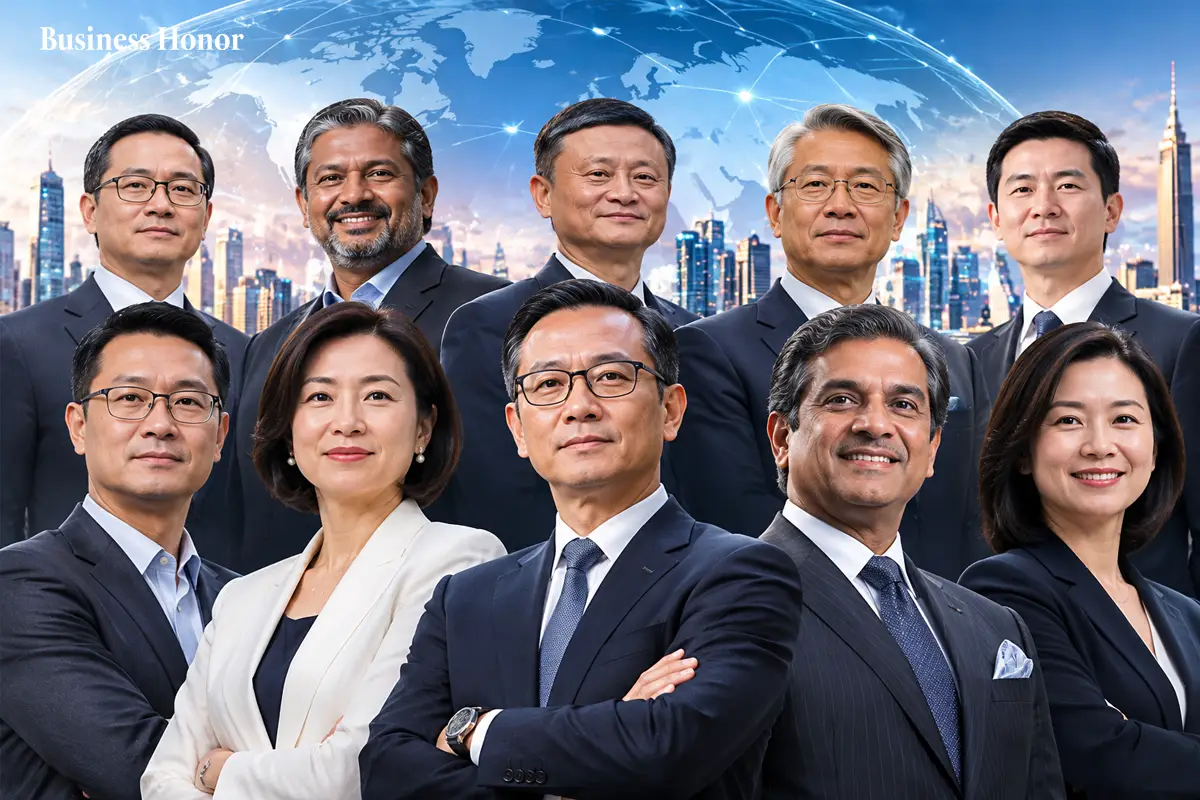
Inspiring business leaders in Asia are setting the pace for global business as 2027 approaches. The region has outgrown its role as a factory floor for Western brands. It now leads in batteries, low-cost AI, digital finance and consumer platforms, and the IMF’s regional outlook keeps Asia and the Pacific at the center of global growth.
Why are investors watching boardrooms in Singapore, Hangzhou, Mumbai and Tokyo? Because the companies run by these successful business leaders in Asia now control key links in artificial intelligence, electric vehicles and consumer banking.
This report profiles the top CEOs in Asia 2027 and the most influential leaders in Asia: ten executives whose decisions are changing how companies elsewhere operate.
Top 10 Inspiring Business Leaders in Asia 2027
1. Tan Su Shan | CEO, DBS Group (Singapore)
Tan Su Shan ranks first on Business Honor’s list of the Top 10 Inspiring Business Leaders in Asia 2027. Since March 2025 she has led DBS Group as the first woman and first insider to run Southeast Asia’s largest bank. Her priority is making AI routine. DBS has built more than a thousand models and expects AI and data work to add about S$1.1-1.2 billion in value for 2025, up from roughly S$750 million in 2024. She wants a “gen-AI bank with a heart,” and caution comes with it. After the 2023 outages, the Monetary Authority of Singapore ordered a six-month pause on non-essential IT changes.
“Resilience remains the bedrock of our organisation.” Tan Su Shan, DBS 2025 annual report
2. Liang Wenfeng | Founder and CEO, DeepSeek (China)
Liang came to AI from quantitative trading. His fund, High-Flyer, financed DeepSeek in its early years, and its V2 model, priced near one yuan per million tokens of inference, set off a price war across China. R1 followed in January 2025 and rattled the industry. 36Kr reports DeepSeek began raising outside capital in April 2026. Can a lab built on research-first instincts keep them once investors expect returns?
“The moat formed by closed-source systems is short-lived.” Liang Wenfeng, in a translated interview
3. Mukesh Ambani | Chairman and MD, Reliance Industries (India)
Ambani remade telecoms with Jio and shopping with Reliance Retail, and at the June 2026 AGM he marked ten and twenty years of each. His next target is AI. Reliance Industries says Reliance Intelligence has entered its execution phase, with the first 120 MW of AI compute due in Jamnagar by the end of 2026. The board also approved the Jio Platforms prospectus for filing with SEBI. The bet depends on repeating Jio’s leap in affordability, this time for AI.
“India should not be a mere consumer of AI created elsewhere.” Mukesh Ambani, at the 49th Reliance AGM
4. Dr. Robin Zeng | Founder, Chairman and CEO, CATL (China)
Fortune notes that CATL makes over a third of the world’s EV batteries. Zeng holds a physics PhD and received the NAATBatt Lifetime Achievement Award. He is also candid. At the 2026 World Laureates Forum he said battery energy density still falls short of many needs and that AI can speed up materials discovery. Beyond cars, he points to Pakistani cement plants that halved electricity costs by pairing solar power with CATL storage.
“Open innovation is the key to supercharging the green energy transition.” Dr. Robin Zeng, One Earth Summit
5. Falguni Nayar | Founder and CEO, Nykaa (India)
Nayar spent nearly two decades in investment banking at Kotak Mahindra before founding Nykaa in 2012 at 49, with no beauty or retail background. It listed in 2021, and Fortune calls her the first Indian woman to take a unicorn public. She has said she would rather sell the right lipstick shade at full price than the wrong one at half. That bias for margin over volume helped Nykaa avoid the discount-driven burn that sank many consumer startups.
“I didn’t know beauty, I didn’t know retail. And I gave myself a chance.” Falguni Nayar, in a Fortune interview
6. Wang Chuanfu | Founder, Chairman and CEO, BYD (China)
Wang founded BYD in 1995 to make phone batteries, then bet on cars. His method is vertical integration, with batteries, chips and software built in-house, and he calls himself one of BYD’s roughly 120,000 engineers. By his own account, BYD put over 8 billion yuan into R&D in 2019 against net profit of 1.6 billion. From January to October 2026, BYD sold more than 1.5 million vehicles overseas, and overseas revenue passed domestic revenue in the first half. The Economist has asked whether such tight integration can keep pace as software gains weight.
“We must return to the essence of technology.” Wang Chuanfu, at BYD’s June 2026 shareholder meeting
7. Nithin Kamath | Co-founder and CEO, Zerodha (India)
Kamath started Zerodha in 2010 with his brother Nikhil and never took outside investment. The result is India’s largest retail broker, built on low fees, no debt and free education through Varsity. He is also frank about his industry. He has noted that most derivatives volume comes from a small slice of traders, and in 2026 he wrote that wealth concentration is getting worse. That honesty builds trust advertising cannot buy.
“For India to grow inclusively, wealth has to be created locally.” Nithin Kamath, in a post reported by Business Today
8. Zhang Yiming | Co-founder, ByteDance (China)
Zhang founded ByteDance in 2012 on a conviction that algorithms could match people to content better than editors could. Douyin arrived in 2016, then TikTok. He stepped down as CEO in 2021 and handed daily management to Liang Rubo, but stayed close to the technology. The Information reported, via 36Kr, that he told ByteDance’s Seed team not to rely on distilling rivals’ models, a choice that may cost speed now for independence later.
“Courage and imagination to do things that are more difficult to reach.” Zhang Yiming, in a translated 2021 speech
9. Suphachai Chearavanont | Senior Vice Chairman, Charoen Pokphand Group (Thailand)
Suphachai ran CP Group as CEO for nine years, according to McKinsey, steering the conglomerate across agriculture, telecoms, retail and finance toward digital and low-carbon operations. During the pandemic, he adopted a no-layoff policy and reskilled staff into tech roles, the Bangkok Post reported. He now chairs Global Compact Network Thailand.
“Run our business with purpose, not only for profit.” Suphachai Chearavanont, in a UN News interview
10. Tadashi Yanai | Founder, Chairman and CEO, Fast Retailing (Japan)
Yanai has led Fast Retailing since 1984, building Uniqlo around “LifeWear”: plain, durable clothing designed to last. He wants the group to be the world’s top apparel brand, including in North America and Europe, and once joked it might reach “number 0.” Automation, inventory tagging and an all-product recycling program back the ambition.
“Creating a better world through clothes.” Tadashi Yanai, in Fast Retailing’s CEO message
What Sets Successful Business Leaders in Asia Apart in 2027
Three strengths run through these profiles.
-
Spending discipline over hype. DeepSeek’s lean models and Zerodha’s debt-free growth show that steady profit and strong engineering outlast heavy cash burn.
-
Control of supply chains. CATL, BYD and Reliance secure their own materials, plants and power, which protects them from sudden shortages.
-
Practical AI. These firms put AI to work in banking, retail logistics and factory lines instead of keeping it in research labs.
The Challenges Ahead
None of this is guaranteed. Tariffs, chip export limits and stricter data rules push leaders to build local supply chains in every major market. BYD shows the pressure: China halved its purchase-tax exemption for new energy vehicles in January 2026, and exports took on a larger role.
Can vertical integration keep pace as software takes over from hardware? How well these executives balance global growth with local rules will decide their standing in 2027.
Business Honor’s view is that the inspiring business leaders in Asia share one habit: they plan in decades, not quarters. By combining technical ownership with careful spending, they have shifted the balance of power in banking, clean energy and AI. The top CEOs in Asia 2027 show leaders everywhere that lasting success belongs to companies that pair sound engineering with healthy profits.
FAQ:
Who are the inspiring business leaders in Asia in 2027?
The inspiring business leaders in Asia named by Business Honor are Tan Su Shan (DBS), Liang Wenfeng (DeepSeek), Mukesh Ambani (Reliance), Robin Zeng (CATL), Falguni Nayar (Nykaa), Wang Chuanfu (BYD), Nithin Kamath (Zerodha), Zhang Yiming (ByteDance), Suphachai Chearavanont (CP Group) and Tadashi Yanai (Fast Retailing).
Who are the top CEOs in Asia 2027?
The top CEOs in Asia 2027 on this list include Tan Su Shan, Liang Wenfeng, Robin Zeng, Wang Chuanfu and Nithin Kamath, who lead companies in banking, AI, batteries, electric vehicles and investing.
What sets successful business leaders in Asia apart?
Successful business leaders in Asia pair capital discipline with control of key supply chains. Many also put AI to work in daily operations, not only in research.
Which industries do the most influential leaders in Asia shape?
The most influential leaders in Asia here shape banking, artificial intelligence, batteries, electric vehicles, fintech, retail, telecoms and apparel.
How did Business Honor choose these business leaders in Asia?
Business Honor made an editorial selection based on strategic impact, innovation and long-term execution, not a single financial ranking.






































.webp)
.webp)



Comments
0 Comments