
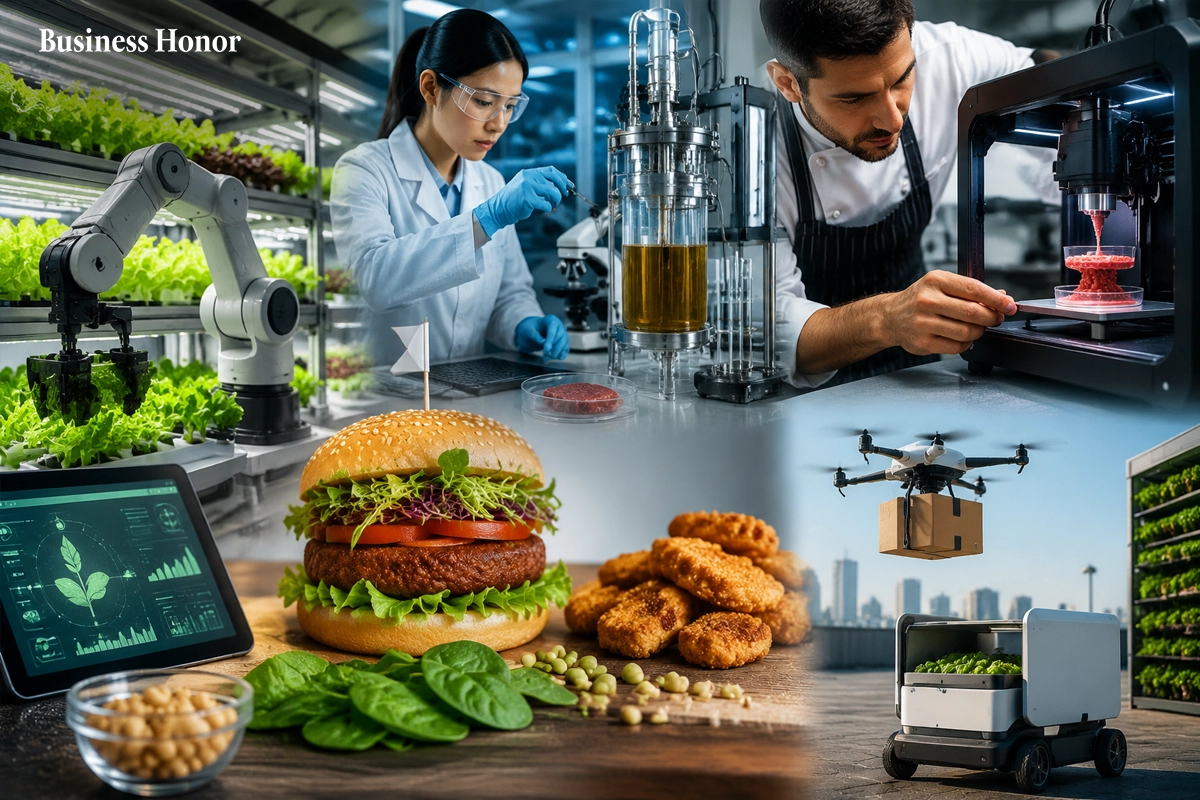
In 2026, the world's food ecosystem is being transformed by the Best FoodTech Companies as core technology becomes a competitive advantage for businesses all over the world. Food technology businesses are revolutionizing the production, delivery, and consumption of food through anything from automated restaurants and supply networks driven by artificial intelligence to sustainable agriculture and customized nutrition.
The global food ecosystem is about to enter a new phase where technology is considerably more advanced than isolated industrial facilities or specialized testing labs. Global food businesses and leading Food technology companies are adopting smarter systems due to changing consumer demands, climate pressures, increased operational costs, and rapid digital transformation. Advanced logistics, robots, artificial intelligence, and predictive analytics are becoming essential tools for businesses looking for long-term commercial success, operational resilience, and efficiency.
Which companies can successfully combine technology, consumer understanding, and operational excellence to shape the future of food?
Business Honor presents its curated list of the Top 10 Best FoodTech Companies of 2026, highlighting businesses that use digital platforms, automation, sustainability programs, and technology to change the global food scene. By creating robust supply chains, enhancing customer experiences, creating healthier goods, and developing scalable operational models for a changing market, these companies embody the future of food innovation.
Top 10 Best FoodTech Companies of 2026
- Nestlé (NESN.SW)
CEO: Philipp Navratil
Company Overview: Headquartered in Vevey, Switzerland, Nestlé is the world's largest food and drink company by sales and market value. Its vast product lineup ranges from household coffee brands like Nespresso and Nescafé to pet food under the Purina label, alongside infant nutrition and popular chocolate treats.
Strategic Priorities: Under its leadership team, Nestlé concentrates on building out its specialized medical nutrition products, growing its high-profit premium coffee systems, and cutting carbon emissions across its international farm supplier network.
Business Impact: Nestlé stays on top by shifting toward higher-priced product lines and making its supply chains cleaner and more sustainable.
- McDonald's Corporation (MCD)
CEO: Chris Kempczinski
Company Overview: Based in Chicago, Illinois, McDonald's is the clear global leader in fast food. The company runs and franchises tens of thousands of restaurants in nearly every corner of the world.
Strategic Priorities: Growth is driven by its core corporate strategy, which focuses on seamless mobile ordering, expanding the MyMcDonald's Rewards loyalty program, smart drive-thru technology, and region-specific menu innovation. The company is also leveraging AI in food industry applications to enhance customer engagement, improve demand forecasting, and optimize restaurant operations.
Business Impact: McDonald's uses digital tools, customer reward apps, and faster drive-thru technology to boost sales and keep kitchen speed high.
- Unilever PLC (UL)
CEO: Fernando Fernandez
Company Overview: Headquartered in London, United Kingdom, Unilever is a consumer goods giant with major global operations in packaged foods, ice cream, and personal care items. Famous food brands include Knorr, Hellmann's mayonnaise, and Magnum ice cream.
Strategic Priorities: Unilever is streamlining its business to focus resources on its biggest "power brands." This plan aims to speed up sales growth and make operations far more efficient in fast-growing developing markets.
Business Impact: Unilever is cutting back on smaller lines to double down on its strongest global brands and sell more in emerging economies.
- DoorDash, Inc. (DASH)
CEO: Tony Xu (Co-Founder)
Company Overview: Based in San Francisco, California, DoorDash dominates local food delivery across North America and is expanding its footprint throughout Europe and the Asia-Pacific region.
Strategic Priorities: DoorDash has moved far beyond simple takeaway food delivery into local grocery, convenience store, and retail drop-offs. It also offers white-label delivery tech (DoorDash Drive) powered by smart software that maps out the fastest driver routes.
Business Impact: DoorDash uses smart routing software to transform from a simple restaurant app into a complete local delivery service for all retail goods.
- Mondelēz International (MDLZ)
CEO: Dirk Van de Put
Company Overview: Located in Chicago, Illinois, Mondelēz International is a global leader in everyday snacks, owning household name brands like Oreo, Cadbury, Ritz, and Toblerone.
Strategic Priorities: The Company focuses closely on core snack categories, particularly biscuits and chocolates. It uses digital software to track its supply chain, sources cocoa sustainably through its Cocoa Life initiative, and buys smaller regional snack brands to grow its footprint.
Business Impact: Mondelēz builds its business around core snack favorites while making its supply chains digital and sustainably sourced.
- Compass Group PLC (CPG.L)
CEO: Dominic Blakemore
Company Overview: Headquartered in Chertsey, United Kingdom, Compass Group is the largest food service contract company in the world. It provides catering for office buildings, hospitals, colleges, sports stadiums, and remote industrial sites.
Strategic Priorities: Compass relies on smart tech to scale up its work. It builds micro-markets in offices, sets up self-checkout automated cafeterias, and designs flexible dining programs suited for modern hybrid office workers.
Business Impact: Compass also reflects how Food automation companies are transforming large-scale dining through intelligent service models and operational efficiency.
- Hindustan Unilever Limited (HINDUNILVR.NS)
CEO: Priya Nair (Managing Director)
Company Overview: Based in Mumbai, India, Hindustan Unilever (HUL) is India's largest consumer goods firm, reaching nine out of ten households across the country. In the food sector, it manages trusted consumer brands like Horlicks, Boost, Kissan, and Brooke Bond tea.
Strategic Priorities: HUL connects directly with millions of small neighborhood grocery stores ("kiranas") using its custom AI ordering app called Shikhar. This app simplifies supply chains and automates reorders for small store owners.
Business Impact: HUL uses direct mobile ordering tools to connect factory floors straight to millions of small neighborhood shopkeepers across India.
- Danone S.A. (BN.PA)
CEO: Antoine de Saint-Affrique
Company Overview: Headquartered in Paris, France, Danone leads global markets in fresh dairy, plant-based foods, specialized infant nutrition, and bottled water brands like Evian and Volvic.
Strategic Priorities: Guided by its "Renew Danone" business plan, the company is simplifying its workplace structure, expanding profitable infant and medical nutrition lines, and reformulating classic yogurts to meet consumer demand for gut health and high protein.
Business Impact: Danone focuses its product line on health-focused items like protein-packed dairy, gut-health foods, and specialized medical nutrition.
- JBS N.V. (JBS)
CEO: Gilberto Tomazoni (Global CEO)
Company Overview: Based in São Paulo, Brazil and Greeley, Colorado, JBS is the largest meat processor in the world, supplying beef, pork, poultry, and pre-made meals to grocery stores and restaurants globally.
Strategic Priorities: Through flagship brands like Swift, Pilgrim's Pride, and Seara, JBS focuses on growing its higher-margin packaged meat sales, funding plant-based protein options, and placing digital tracking tools along its livestock supply chain.
Business Impact: JBS grows by selling more packaged meat products, investing in alternative proteins, and adding digital tracking from farm to table.
- Chipotle Mexican Grill, Inc. (CMG)
CEO: Scott Boatwright
Company Overview: Headquartered in Newport Beach, California, Chipotle is a pioneer in fast-casual dining, famous for its custom burritos, fresh ingredients, and responsibly raised meats.
Strategic Priorities: Chipotle leads the industry in kitchen efficiency. It speeds up service using drive-thru order-ahead lanes ("Chipotlanes"), automated kitchen prep tools (like automated avocado choppers and smart grills), and steady restaurant expansion.
Business Impact: Chipotle boosts restaurant profits by pairing fresh food prep with smart kitchen automation and quick drive-thru pickup lanes.
Why the Best FoodTech Companies Are Reshaping the Global Food Industry
The rise of the top FoodTech Companies reflects a permanent shift across the commercial landscape. Modern technology is no longer an optional overlay; it functions as a core driver of business performance. Food platforms now deploy intelligent automation, predictive systems, and real-time network tracking to address critical challenges ranging from distribution delays to resource efficiency. The most resilient organizations do not simply adopt digital tools; they integrate them directly into their core operating models.
At the same time, the competitive landscape is growing increasingly sophisticated. Established consumer packaged goods giants now operate alongside Food innovation companies, digital logistics networks, automated equipment developers, and specialized ingredient innovators introducing new ways to produce and distribute goods.
Business Honor believes that the future leaders will not win through brand size alone, but through their ability to adapt and execute using technology. The outcome rests entirely on practical discipline. The market will belong to companies that combine smart tools with steady daily execution to secure long-term success.
The Leadership Advantage in 2026
For investors, entrepreneurs, and executive decision-makers, tracking the growth of food technology platforms offers clear insight into where global commercial markets are heading.
The coming decade will be shaped by organizations that successfully balance technical capability, sustainable practices, changing consumer preferences, and daily operational efficiency. From automated logistics to modernized kitchens and functional nutrition, the global food system is becoming deeply interconnected.
The best FoodTech leaders of 2026 demonstrate that the future of food extends far beyond increasing production volume. It centers on building smarter, more sustainable, and more reliable operating models for a global market.
































.webp)
.webp)



.webp)



Comments
0 Comments