
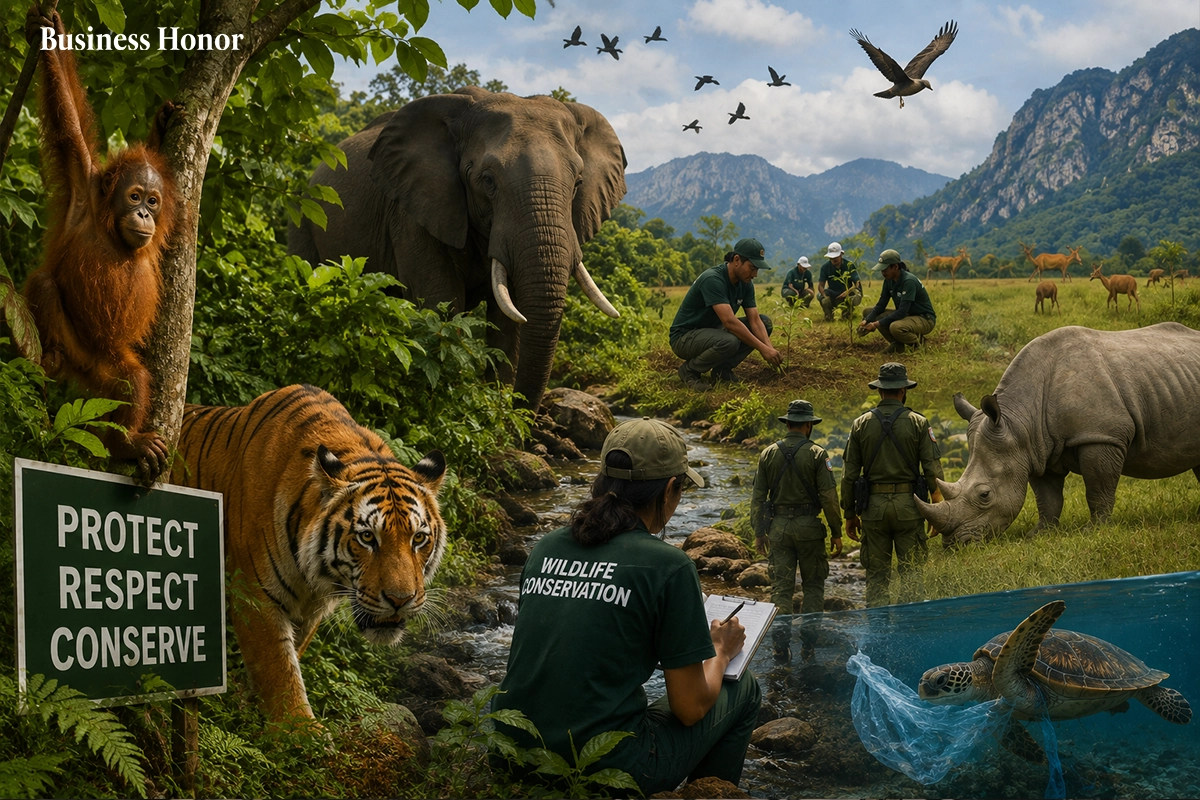
Animal Welfare & Wildlife Conservation 2026 Discussions show us the tough truth that protecting animals is connected to protecting the places they live. Animals that live in forests, seas, savannas, wetlands, and even cities are facing problems such as people destroying their homes, changes in the weather, hunting, pollution from factories, and expanding human development.
The whole world needs to take action to address these problems. We need measures that really work to support Animal Welfare & Wildlife Conservation.
Governments enforce legal measures under national legislation such as India's Prevention of Cruelty to Animals Act, 1960 and penal codes like the Bharatiya Nyaya Sanhita, 2023. Statutory bodies, including the Animal Welfare Board of India (AWBI) and the National Tiger Conservation Authority (NTCA), work with officials to implement welfare policies. At the same time, individual animal welfare ties directly into large-scale ecological management.
Protecting the Places Animals Call Home
Proper protection begins with the physical ground. Due to deforestation, rivers become polluted, and migration routes can become obstructed by concrete highways, making it difficult for species to survive. For that reason, programs target entire landscapes instead of individual animals, supported by laws such as the Wild Life (Protection) Act, 1972.
Habitat restoration projects are working to fix damaged forests in Africa, Asia, and Latin America.
People are starting to see that wetlands are really important because they can help prevent floods and are also places where many animals have their young.
This is happening because of the Ramsar Convention on Wetlands. Habitat restoration projects and marine protected areas are also helping to keep reefs, sea turtles, and fish in the open ocean safe. Habitat restoration projects are doing an important job of protecting these ecosystems, while marine protected areas help protect coral reefs, sea turtles, and open-ocean fish species. It is significant for the health of our planet.
Migratory animals bring distinct challenges across ecosystems:
-
Elephants require broad open land to move and feed safely without encountering barriers.
-
Big cats need expansive territories to hunt and raise young without territorial interference.
-
Migratory birds depend on healthy seasonal wetlands along global air routes.
-
Marine mammals cross international ocean boundaries where local laws vary widely.
Protecting just one part of a migration route leaves animals exposed to harm elsewhere. International treaties like the Convention on the Conservation of Migratory Species of Wild Animals (CMS) reinforce these travel routes. Corridors in protected land areas link parts of the environment, giving animals a way to move between places where they eat, mate, and rest. Making these paths available is one of the challenges for animal welfare and conservation, particularly in countries that are growing quickly.
Endangered Species Need Early Action, Not Just Rescue
Waiting until a species is listed as endangered on the IUCN Red List of Threatened Species is not a good idea because it becomes really hard to help the species recover. It can also become very expensive, and the outcome remains uncertain.
If we take action early, we can prevent a lot of problems and get better results over time.
There are things we can do to help. For example, we can count the number of animals regularly and map out the land. We can also have rangers patrol the area and start breeding programs for species. The Convention on International Trade in Endangered Species, or CITES for short, helps us stop people from trading endangered species.
All these things help to keep species safe. It is much better to stop the population of a species from decreasing in the first place than to try to rebuild a species that has already disappeared, which is very difficult.
Modernizing Anti-Poaching and Intelligence Operations
Illegal trade continues to take away wildlife that is already at risk. Criminal networks target elephants for ivory, rhinos for horns, and pangolins for scales. They also catch reptiles and birds to sell in stores. Organizations like TRAFFIC work with border agencies to stop these groups.
Conservation teams use updated field tools and technology to catch poachers early:
-
Trail cameras and satellite pictures reveal tree cutting and site intrusions quickly.
-
Tracking collars follow animal paths and send warnings if animals enter high-risk zones.
-
Drones fly over remote, rough areas to watch for suspicious movement.
-
DNA testing lets customs officers match seized animal parts back to their home region.
Park rangers, crime investigators, wildlife doctors, border officers, and local trackers all help law enforcement do its job on the ground, keeping the land safe and making sure everyone follows the rules.
They need people on the ground to really protect the land and enforce safety rules.
Training people who live in these communities to help with field patrols is important because it gives them jobs and ensures that more people are watching what is going on.
When people from the local community work as forest guards, they can get information to the authorities much faster, and the information can be more reliable for regional authorities, park rangers, crime investigators, wildlife doctors, border officers, and local trackers.
Managing Human-Wildlife Conflicts
Keeping animals safe gets complicated when human towns and wild animals share borders. As farm fields, highways, and housing developments spread into natural spaces, run-ins between humans and animals rise.
Elephants walk into farms to eat crops, large predators move into village edges, and bears forage for food near houses. For people living near forest borders, safety and income matter just as much as animal protection.
In cities, stray populations follow statutory guidelines like the Animal Birth Control Rules, 2023, which mandate humane sterilization and rabies vaccination through local municipal programs.
Extending Animal Welfare to Wild Populations
Animal care used to focus mainly on pets, farm livestock, and working animals. Today, wild animals receive similar care and attention, backed by standards from the World Organisation for Animal Health (WOAH). Wild animals suffer injuries, starvation, sickness, high stress, and habitat loss due to human choices.
Sea life eats floating trash, sea turtles get tangled in old fishing lines, birds hit tall building glass, and forest fires burn nesting sites. Noticing these challenges encourages field teams to care for individual animals while tracking whole species populations.
Field rescue units now receive training to treat injured animals directly in the wild. Quick medical care allows recovered animals to return to their natural herds without long periods in captivity.
Captive Care and Ethical Wildlife Tourism
People who travel and groups that care about animals really look at how tourist places treat animals that are captured. Tourist places that let people ride elephants, watch animal shows, or touch animals get a lot of criticism from visitors and people who care about animal welfare. The World Association of Zoos and Aquariums makes rules that say animals should have suitable homes, good food, and space to move around naturally.
Ocean Protection Demands Equal Priority
While nature discussions often focus on land forests, oceans hold much of the world's plant and animal life. Global rules like the UN Convention on the Law of the Sea (UNCLOS) set basic ocean laws, but marine habitats still face threats from big fishing fleets, plastic garbage, coastal building, cargo ships, underwater noise, and warming water.
Sea turtles swallow plastic bags, whales get hit by ships or stuck in nets, and coral reefs lose color and die as waters warm. Marine protected areas offer safe spaces, but they need active boat patrols to work. The future of marine Wildlife Conservation depends on smart fishing rules set by organizations like the Food and Agriculture Organization (FAO), lower waste dumping, and careful coast development.
Protecting coastal mangrove forests serves a double purpose. Mangroves store carbon while creating vital nursery habitats for ocean fish, shellfish, and coastal bird species.
Building Climate Resilience into Planning
Shifting weather, changing rain, extreme heat, and broken habitats hit animals directly. Reports from the Intergovernmental Panel on Climate Change (IPCC) show that animals with specific living needs face fast risks when heat changes breeding seasons, dries up drinking holes, or sparks forest fires.
Polar animals lose hunting ice, ocean corals suffer in hot water, and migrating birds arrive at nesting sites only to find their usual insect food missing.
Planning focuses on helping nature adapt:
-
Rebuilding large connected land zones lets animals move north or uphill as temperatures rise.
-
Protecting river systems secures clean drinking water during long dry spells.
-
Keeping genetic diversity high helps animal populations adapt to changing land conditions.
The goal centers on giving wild species the space and health needed to handle environmental changes over time.
Livestock Management & Food System Welfare
Global animal policy impacts billions of livestock within agricultural supply chains. The daily welfare of cattle, poultry, swine, and small ruminants depends directly on stocking density, transport conditions, veterinary access, nutrition, and humane handling.
Regulatory guidance from institutions like India's Department of Animal Husbandry and Dairying, alongside global welfare benchmarks, promotes transparent reporting, improved housing, and low-stress handling practices. Higher agricultural welfare standards reduce farm pollution and lower disease transmission risks, benefiting both animal and public health.
The Practical Value of World Wildlife Day
International observances like World Wildlife Day on March 3, established by the United Nations General Assembly, provide a regular platform to advance conservation education and policy dialogue.
The event spotlights lesser-known organisms that perform critical ecological functions, reinforcing the message that biodiversity relies on all native species. Public engagement shapes consumer choices, drives sustainable travel habits, encourages funding, and holds leadership accountable to commitments under the UN Convention on Biological Diversity (CBD). Educational workshops held on this day equip students with a practical understanding of local ecosystems, fostering long-term environmental stewardship.
Recognizing Excellence in Protection
Behind every species recovery are field veterinarians, park rangers, researchers, and local volunteers operating in demanding environments.
Public recognition builds operational momentum. Flagship initiatives like Project Tiger demonstrate the impact of sustained government backing. Formal accolades, such as the Animal Welfare & Conservation Excellence Award 2026, honor frontline personnel who deliver measurable improvements in animal safety. Highlighting these practical achievements provides scalable models for other conservation districts while encouraging ongoing institutional funding.
The Path Forward
Business Honor examines the future of wildlife conservation, which depends on action over debate. Securing wild species requires four essential priorities: protected habitats, smart land management, strong community partnerships, and enforced legal rules. None of these works in isolation.
Protecting biodiversity takes steady, well-funded choices across farms, forests, cities, oceans, and rural towns worldwide. Safeguarding these habitats today is the only sure way to build a healthy, resilient world for generations to come.
FAQ:
How does Animal Welfare & Wildlife Conservation in 2026 depend on habitat protection?
Safeguarding species requires preserving the intact ecosystems and natural corridors where wild animals live and breed.
What are the top Welfare & Conservation Challenges facing wild populations today?
The main threats are habitat fragmentation, climate variability, industrial pollution, poaching, and expanding human developments.
How do national laws and statutory bodies enforce wildlife protection?
Statutory bodies use national statutes to establish welfare standards, mandate ranger patrols, and legally safeguard animal habitats.
Why is early intervention vital for endangered species recovery?
Taking early preventive action stabilizes vulnerable populations before they drop into crisis, making recovery easier and far more reliable.
How do advanced technologies modernize anti-poaching operations?
Field teams use satellite cameras, GPS collars, drones, and forensic DNA testing to detect poachers and track illegal trade in real time.



































.webp)

.webp)




.webp)



Comments
0 Comments