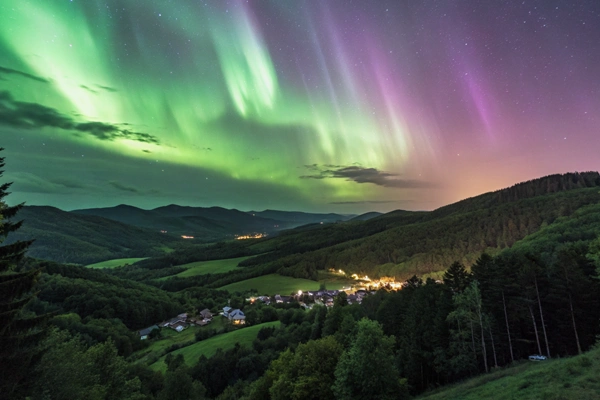
Celestial Spectacle Defies Geographical Limits in Extraordinary Astronomical Phenomenon.
Astrophotographer Egon Filter took a stunning picture of the aurora south of Brazil, challenging conventional notions of where such a phenomenon might be found. The photograph was taken on January 19, 2013 during extremely strong geomagnetic storms that drove aurora activity far beyond its customary range. The aurora, captured at Cambará do Sul, a location in the state of Rio Grande do Sul, was a subtle purple and red glow visible in the night sky, located between 27° and 33° S latitude, well outside the typical southern auroral zone of 60° - 70° S.
The auroras are typically only visible at or above high latitudes (near Earth’s magnetic poles), with southern hemisphere sightings generally limited to those parts of the world that are close to Antarctica. Egon Filter’s long-held dream of capturing an image of the aurora australis was unexpectedly fulfilled because of the major geomagnetic storm weather that expanded the extent to which the aurora was visible. Auroras are formed when charged particles from the solar wind interact with the Earth’s magnetic field and atmosphere, resulting in displays of colored light in the sky. Geomagnetic storms can enhance solar wind-Earth environmental interactions, occasionally extending the aurora to lower latitudes than normally exhibit auroras.
Researchers are describing this unique sighting as one caused by an intense solar storm that caused the auroral zone to extend much farther than it normally does. Because of the infrequency with which these events happen, Filter's picture can be seen as an important astronomical record. Filter's image will serve to illustrate how unpredictable and magnificent space weather is. It also illustrates how unusual and magnificent celestial events may occur outside of their expected locations, captivating the imaginations of astronomers and sky observers.

































.webp)

.webp)




.webp)