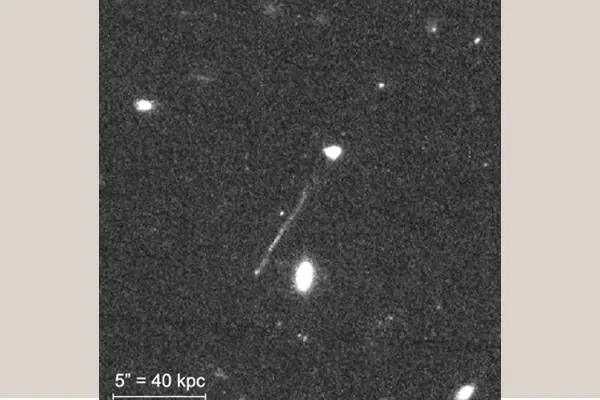
The mysteries of the universe are still unfolding, and one of the newest discoveries from the James Webb Space Telescope proves to be a foundation for understanding black holes. The discovery of a runaway supermassive black hole that weighs 10 million times as much as our sun, and is traveling at 2.2 million miles per hour through Cosmic Owl Galaxy. Not only does this discovery tell us about an incredible velocity for a celestial object, but it also demonstrates an energy output that is 3,000 times greater than the speed of sound. The discovery of this runaway black hole leads to an even larger area of study beyond simply the formation and behavior of black holes. The runaway black hole leaves behind a galaxy sized wake that pulls in gas and dust and leads to new star formation over a distance of 200,000 light years. Scientists will continue to study this to learn more about the universe and how celestial objects interact with each other.
The Discovery's Significance
The discovery of a moving supermassive black hole is a landmark accomplishment that drastically alters the way we think about how they move around and what their impact is on the formation of galaxies. Pieter van Dokkum from Yale University who was part of the Discovery Team says that it is "mind blowing" that something that large can travel so fast and that it takes that much energy to push an object of this size across the universe. The existence of these black holes raises two important questions. One is how do supermassive black holes get to be so fast. The other is how will they affect the galaxies that they pass through.
The research team used the Hubble Space Telescope to identify signs of the presence of this object that was moving through space. This research illustrates how collaborative the current approaches to astronomy are as large amounts of data were generated from multiple sources using highly sophisticated technology to help illuminate some of the most remote areas of the universe. The extremely high speeds of black holes such as this one challenge our current understanding of black hole dynamics and drive researchers to rethink assumptions about the laws of astrophysics, and to examine more closely the physics of energy and gravity in the context of the universe.
Understanding the “Wake” Created by the Black Hole
The colossal "wake" created by a runaway supermassive black hole as it travels through the universe is one of the most captivating features of its journey. The wake is formed from matter that the black hole attracts gravitationally, causing both nearby gas to be captured and new stars to be created on the long journey of the black hole. When moving through the cosmic medium, the supermassive black hole generates a shock wave through the gas, which allows astronomers to observe this event, including in the most remote regions of the universe where it is very difficult to visualize these kinds of events.
The effect of the supermassive black hole on surrounding matter demonstrates its influence on other nearby celestial bodies while simultaneously illustrating the complexities of force interactions between the supermassive black hole and its surroundings. The matter that is pulled into the path of the supermassive black hole contributes to the structure and dynamics of a galaxy sized object, causing our understanding of how supermassive black holes can affect their surroundings to be completely redefined. The new stars that are formed in the wake of the supermassive black hole represent another level of complexity, highlighting the possibility that supermassive black holes can serve as "catalysts" for stellar formation and can play major roles in forming and shaping galaxies over billions of years into the future.
The Methods of Detection
We will begin with a discussion of the current techniques available to astronomers for detecting super massive black holes. The traditional techniques to find supermassive black holes typically depend on seeing the influences of their incredible mass and gravitational pull that allows astronomers to calculate the properties of the black hole itself. However, in the case of the supermassive runaway black hole, astronomers have implemented some new and innovative techniques to observe the runaway black hole's interactions with other cosmic objects.
This research was made possible by the James Webb Space Telescope (JWST) that has very advanced capabilities and can see the associated shockwaves produced by the black hole moving through space. The shockwaves associated with the runaway black hole provide us with very valuable information about the dynamics of gas and dust. By looking at the interactions of the runaway black hole with its surroundings, scientists are able to deduce the mass, speed, and trajectory of the runaway black hole and provide us with a much clearer image of the effect of a runaway black hole has on the surrounding universe.
Conclusion
This colossal entity streaks across the sky at an astonishing speed of 2.2 million miles per hour (3.5 million km/h), leaving a trail nearly the size of our Milky Way behind it, dragging along material and creating new stars on an incredible scale. As a result, these kinds of events help us understand how galaxies form and evolve and help us better understand the overall framework of our universe.
The discovery emphasizes the ability of innovative astronomy instruments such as the JWST to reveal previously undiscovered information in the far reaches of space. The work of the global scientific community and specifically, the work done by the research team at Yale University is a clear example of how important it is for astronomers to collaborate on major advances in our understanding of the universe. As the findings of the research team at Yale University and those from other collaborating teams are discovered, they will continue to improve our current knowledge of how celestial bodies work and how supermassive black holes fit into the cosmic scheme of things.

































.webp)

.webp)




.webp)