
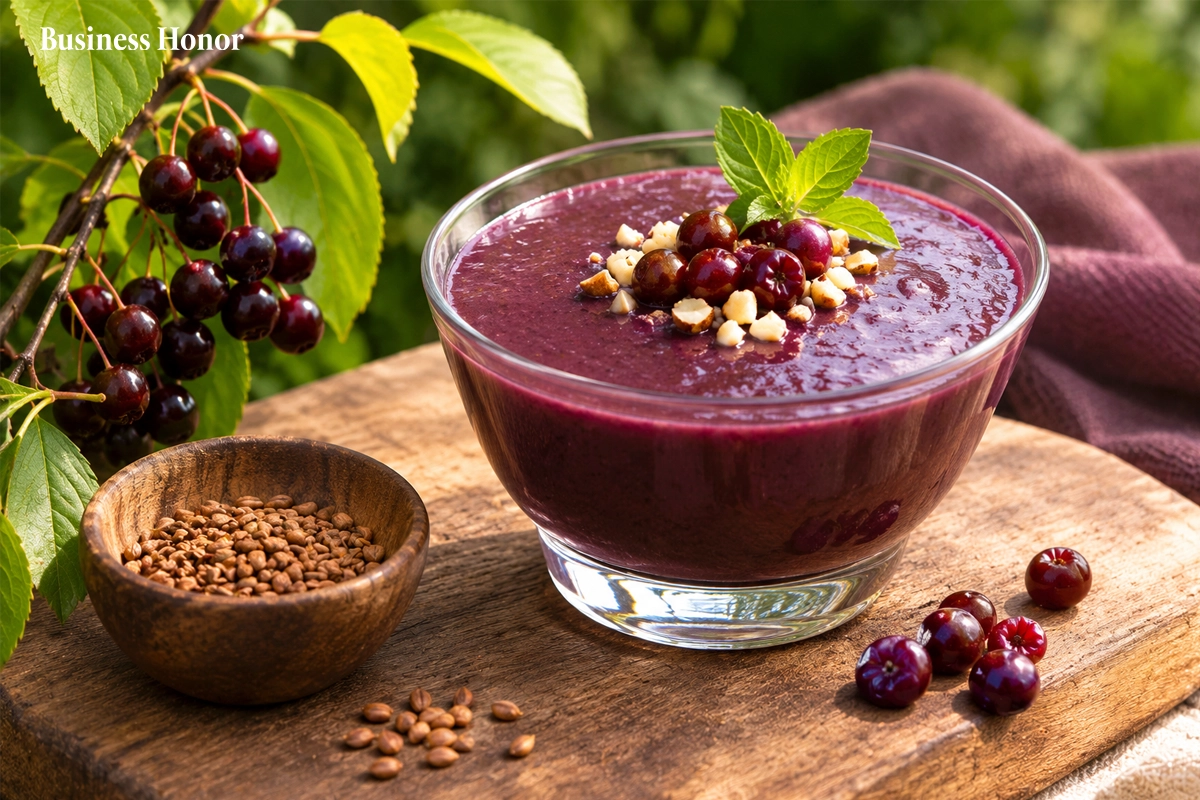
Executive Summary: Traditional chokecherry pudding is far more than a simple meal for Native American tribes. Inside a university lab, high school student Destany "Sky" Pete proved that making the dish the old way with crushed seeds actively fights cancer cells.
Traditional chokecherry pudding has kept Native American tribes with good health for thousands of years. Then modern kitchen shortcuts changed the recipe. Cooks started throwing out a key ingredient, and tribal elders soon noticed more people getting sick. It took a curious teenager from the Duck Valley Indian Reservation to step into a lab and prove why the old recipe works.
The Secret Hiding in the Pit
Destany "Sky" Pete belongs to the Shoshone-Paiute Tribes of the Duck Valley Indian Reservation in Idaho and Nevada. Like almost everyone in her community, she grew up eating wild chokecherries (USDA Natural Resources Conservation Service Chokecherry Plant Guide). In the Paiute language, the dish is called toishabui.
While attending Owyhee High School in Nevada, Pete had a talk with a tribal leader that stuck with her. The elder shared a clear warning. People in the tribe were getting sick more often because they had stopped eating their old foods, especially toishabui.
One small step in the kitchen made all the difference. Many modern cooks simply juice the berries and toss the pits in the trash. Traditional Shoshone and Paiute cooks never do that. They crush the whole berry, seed and all, straight into the pudding. Pete wondered if the real medicine was hiding right inside that crushed seed.
Putting Elders' Wisdom to the Test
Pete wanted hard proof. She teamed up with her high school science teacher, Dietlinde Dann, and contacted Dr. Ken Cornell. Dr. Cornell is a biochemistry professor at Boise State University who studies uterine sarcoma cancer cells.
Inside the Boise State lab, Pete set up a clear test. She made four different chokecherry samples, including plain berry juice, seedless mixes, and the classic recipe with crushed seeds. She placed each sample with uterine sarcoma cancer cells and waited 24 hours.
When she looked through the microscope, the results backed up what elders had known for centuries:
-
The shortcuts failed: Plain chokecherry juice and seedless mixes did nothing to stop the cancer cells from growing.
-
The old recipe worked: Only the crushed-seed pudding slowed down and killed the uterine sarcoma cancer cells.
Pete noted that a longer wait time or a stronger mix could bring even bigger results. She also hopes to run the same test on breast cancer cells in the future.
Taking Culture to the Global Stage
In 2017, Pete entered her work into the Elko County Science Fair in northern Nevada. Out of more than 440 student projects, she won the First Grand Prize. That win earned her a $500 scholarship and special honors from both the U.S. Navy and the U.S. Air Force.
Her victory also sent her to Los Angeles for the Intel International Science Fair (now administered by the Society for Science). There, she stood beside roughly 1,800 high school students from more than 75 countries. She did not take home the top global trophy, yet standing on that stage let her share her culture with the world.
"I'm proud to be Native American," Pete said after the event. "And I want people to know that science and culture can be represented together."
Why This Discovery Matters Today
Business Honor examines that Pete’s work did much more than win science fair ribbons. It proved a simple truth for her community. Ancestral recipes kept people strong for a reason, and modern shortcuts can strip away natural medicines.
After high school, Pete planned to study biology at Stanford University and attend veterinary school at the UC Davis School of Veterinary Medicine. Her dream is to return home to the Duck Valley Indian Reservation and open her own vet clinic. Her story proves that young researchers never have to choose between modern science and their roots. When the two come together, everybody wins.














































.webp)

.webp)



Comments
0 Comments