
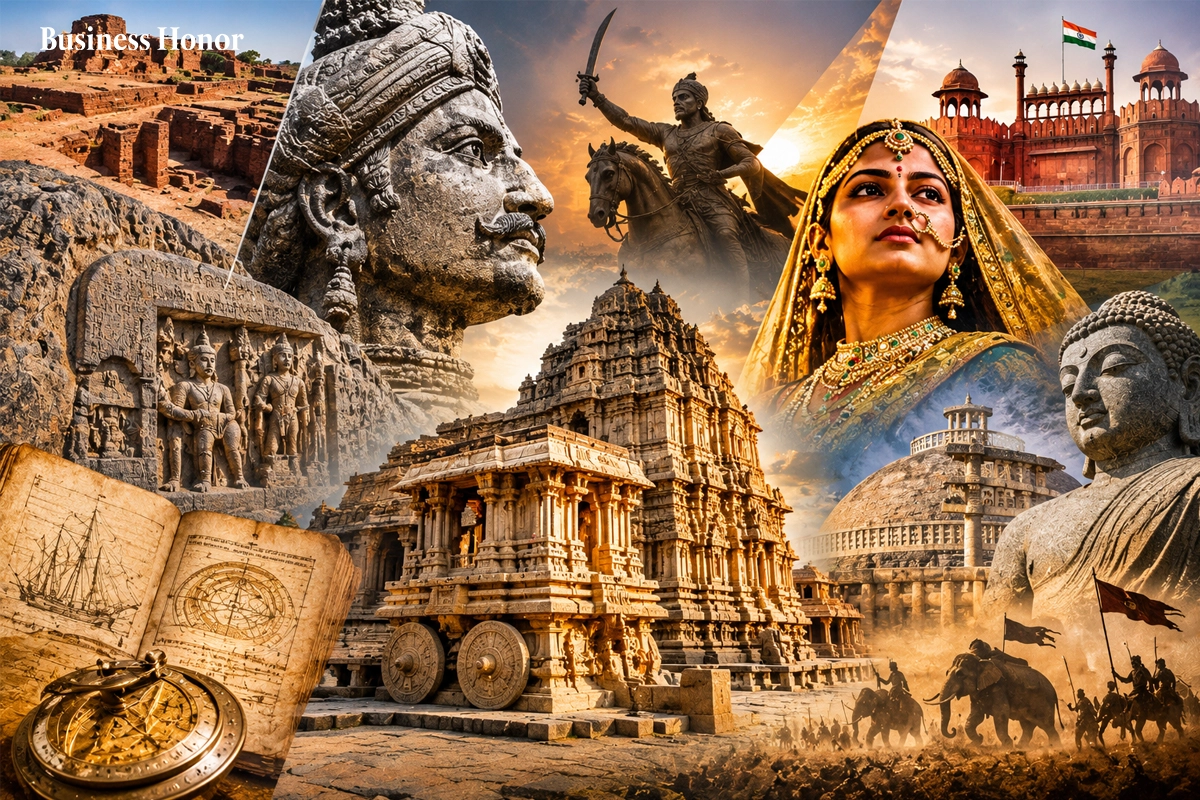
Top 10 Indian historical myths vs. facts: Some of the popular stories about India’s past are not historically accurate. Many of these beliefs have been passed down through the generations, while others have been brought to public attention in books, films and popular accounts. Historical records, archaeological discoveries and research have helped to correct some misconceptions. Business Honor’s listed 10 widely discussed myths and the facts that present a clearer picture of India’s history.
Top 10 Indian Historical Myths vs. Facts
1. Myth: Vasco da Gama Discovered India
Fact: India was already well developed with different Kingdoms, busy ports and good trade links with Arabia, Africa and South East Asia long before Vasco da Gama arrived in 1498. Kozhikode (Calicut) was an important trade port on the Malabar Coast, welcoming traders from around the world.
In May 1498, Portuguese explorer Vasco da Gama reached Calicut having sailed around the Cape of Good Hope in Africa. This created a new sea link from Europe into India, increasing trade for Portuguese traders. However, although Vasco da Gama increased Portuguese involvement in India, India was part of international trade networks for centuries prior to him arriving.
2. Myth: Shah Jahan Built the Taj Mahal as a symbol of his love alone
Fact: Shah Jahan had the Taj Mahal constructed to commemorate his wife Mumtaz Mahal, who passed away in 1631. Although commonly viewed as an expression of their love, the Taj Mahal functioned as more than just a private memorial. As well as being a mausoleum, it was designed to emphasise the power, affluence and aesthetic preferences of the Mughal Empire.
Building on or around 1632 commenced, and the central mausoleum was finished in the 1640s. Persian, Islamic and Indian architectural influences were combined within the structure. Intricate carvings, alongside inscriptions and landscaped gardens, were also incorporated. Today, the Taj Mahal continues to be one of India’s best known buildings. Further consideration of the Taj Mahal’s background, in addition to the legend associated with it, demonstrates why it should be analysed as part of the selection of renowned famous historical myths.
3. Myth: Qutub Minar was built entirely by Qutub-ud-din Aibak
Fact: Qutb-ud-din Aibak began to build the Qutub Minar in Delhi, however the tower was not completed by him. It is believed that he built only the first storey of it. Iltutmish took over the construction and created 3 more storeys. Later on, the tower suffered damage due to lightning. Repairs were made during the rule of Firoz Shah Tughlaq, and an additional storey was also added. More restoration work was done during the rule of Sikandar Lodi.
It has also been restored by subsequent rulers. Firoz Shah Tughlaq repaired the top section which had been damaged by lightning, and Sikandar Lodi also restored the monument. Currently around 72.5m tall, the Qutub Minar continues to be one of Delhi's best known historical sites and is also a UNESCO World Heritage Site. This makes it an interesting example of historical myths debunked through inscriptions and historical records.
4. Myth: Hampi became completely unknown after the Vijayanagr Empire Fell
Fact: Although the Vijayanagara Empire was defeated in the battle of Talikota in 1565, Hampi has not been forgotten completely. Following the battle, the city was greatly affected and much of it was either ruined or left to decay. People still resided in the area, and key places of worship, such as the Virupaksha Temple, were still used.
Despite the empire’s demise, locals and tourists still visit and honour Hampi. In the 19th century British administrators and historians documented Hampi’s temples, buildings and sites of interest by surveying and taking pictures. This raised awareness of what was left of a city which had been the heart of the Vijayanagara Empire. Nowadays, Hampi has been designated a UNESCO World Heritage Site and is a popular destination for international tourists. This is one of the interesting Indian historical myths and facts that shows the difference between a city's decline and its complete disappearance from history.
5. Myth: Purdah was introduced in India only during Mughal rule
Fact: Purdah was not first introduced into India by the Mughals. People had been practicing various methods of veiling and seclusion prior to this. Throughout India’s ancient and medieval history there appears to have been traditions around women’s seclusion. Again, these differed according to region, religion and social class.
Within the Mughal period, purdah was further associated with the royal and noble classes. It has also been proposed that the Mughals incorporated some of these traditions into their lives via marriage alliances with Rajput royal families. This makes the origin of purdah one of the famous Indian history myths that needs to be understood through its wider historical context.
6. Myth: Ancient Indians had no knowledge of surgery
Fact: Medical knowledge was advanced in ancient India. Within the Sushruta Samhita (a medical text written in Sanskrit), various surgical techniques are described. This text is traditionally associated with a physician named Sushruta. This text outlines surgical procedures, surgical tools, treating wounds, fractures and reconstructive surgery.
Rhinoplasty (reconstruction of the nose) is outlined, and there is advice given on how to train as a surgeon. From this text we can see that medical practitioners in ancient India had knowledge of the human body, and techniques to treat injuries and specific illnesses. Therefore, the Sushruta Samhita is an important source of information on the medical development within ancient India.
7. Myth: India was always a poor country
Fact: India has not always had a difficult economic situation. Historically, India has been a key location in global trade. Indian textiles, including cotton, spices and silks were highly sought after by people across Asia, Europe and the Middle East. Many traders from across the world visited Indian ports to trade.
However, research by Economic Historian, Angus Maddison shows that although it did have a high proportion of total world economic output at many points throughout early history, the economic situation in India changed significantly during colonisation. Since gaining independence in 1947, India has struggled to redevelop its economy and increase industrial development.
8. Myth: The 1857 Revolt was only a Sepoy Mutiny
Fact: Although it may initially appear that the Revolt of 1857 was essentially a military mutiny, it in fact quickly developed into a wider movement. Not only did the Indian soldiers (sepoys) working for the British East India Company turn on their British superiors but local princes, gentry, peasants and people in general became involved in the revolt within various areas of North and Central India.
There were many reasons for the Revolt. These related to British rule, the takeover of Indian states and the economic as well as cultural and religious encroachment by the British. Prominent figures such as Rani Lakshmibai, Bahadur Shah Zafar, Nana Sahib and Begum Hazrat Mahal were instrumental in the fight back against the British.
9. Myth: The Konark Sun Temple was built overnight
Fact: It is believed by many people in the local area that the Konark Sun Temple was constructed in one night. It is said that the main architect could not manage to fit the last stone in the structure. As a result, Dharmapada, a child, completed the construction of the temple. Although this story is often used to illustrate bravery and sacrifice, there is no reliable evidence that it was completed in one night.
Historically, the Sun Temple was constructed under the reign of King Narasimhadeva I (of the Eastern Ganga dynasty) in the 13th Century. As a grand Temple for worshipping the Sun God, the Sun Temple has many impressive stone carvings and features the shape of a chariot.
10. Myth: The Indian National Congress was founded by Mahatma Gandhi
Fact: Although Mahatma Gandhi was not one of the early prominent figures in the Indian independence movement, the Indian National Congress was actually formed many years prior to him. It was set up by British civil servant Allan Octavian Hume, and had the backing of Indian leaders including Dadabhai Naoroji and Womesh Chunder Bonnerjee. The Congress' inaugural meeting was in Bombay (now Mumbai), in December 1885. Bonnerjee was even the first President of the Congress.
Around 30 years after its creation, Mahatma Gandhi became a member. Eventually he became one of the key leaders of the Congress and was integral in transforming it into a popular national campaign for independence from Britain. Throughout his leadership, the Congress was heavily involved in well-known independence movements such as the Non-Cooperation, Civil Disobedience and Quit India movements.
Business Honor observes that India's history becomes clearer when popular beliefs are checked against historical evidence.
FAQs
1. Why are some popular Indian historical beliefs considered myths?
Some widely accepted stories about India's past are based on folklore, incomplete accounts or repeated claims rather than reliable historical evidence.
2. Did Vasco da Gama really discover India?
No. India had established kingdoms, trading ports and international trade links long before Vasco da Gama arrived in Calicut in 1498.
3. Did the British build India's railway network for the benefit of Indians?
British colonial authorities mainly expanded railways to support trade, transport raw materials, move troops and strengthen administration.
4. Was the Indian National Congress founded by Mahatma Gandhi?
No. The Indian National Congress was established in 1885, nearly 30 years before Gandhi joined it in 1915
5. How do historians debunk famous historical myths?
Historians examine primary sources, archaeological evidence, inscriptions, official records and contemporary accounts.













































.webp)


.webp)



Comments
0 Comments