
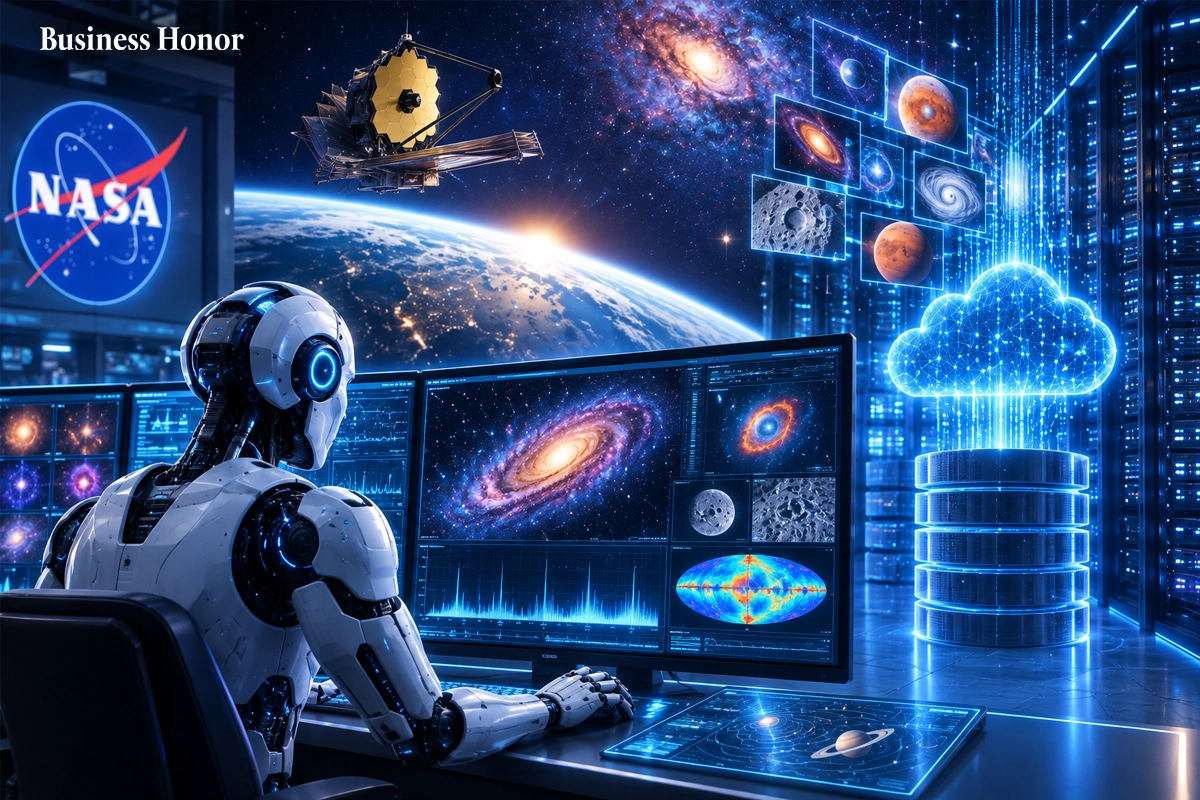
NASA AI data discovery is bringing artificial intelligence to 150 petabytes of mission records, with the goal of finding valuable insights buried in decades of research.
|
NASA AI data discovery is putting more than 150 petabytes of information from decades of space and aeronautics missions under review. NASA is using artificial intelligence to examine vast records that would take human researchers years to study manually.
The effort is part of the NASA AI initiative 2025, launched through the White House’s Genesis Mission in November 2025. NASA announced its participation in July 2026, bringing its extensive scientific archives into a wider federal effort to accelerate research with AI.
Could NASA’s next breakthrough already be sitting in its archives?
NASA’s records include observations from telescopes, satellites, orbiters, landers and aeronautics programs. Many were collected to answer specific questions at the time. New analytical tools now allow researchers to examine the same information from different perspectives.
AI can quickly process massive datasets, compare records from different missions and identify patterns that deserve closer scientific review. This could help researchers revisit older observations and find links that were not visible when the data was first collected.
The scale of the NASA space data archives makes the project particularly important. Decades of observations represent an enormous research resource, especially as scientists investigate increasingly complex questions about space, Earth and technology.
The broader Genesis Mission involves more than 15 federal agencies and aims to connect scientific data, computing resources and AI capabilities. The goal is to make research faster while extracting greater value from information already collected.
Nevertheless, there is a clear limit. AI can identify patterns, but scientists must determine whether those patterns have real meaning. Findings still require testing, verification and independent review before they can be treated as scientific discoveries.
NASA’s data may hold answers that were impossible to see decades ago. AI now offers a faster way to search them, but discovery still depends on proof. Business Honor asks Will NASA’s next breakthrough come from space or from the data already stored on Earth?











.webp)



.webp)

.webp)




.webp)


Comments
0 Comments