
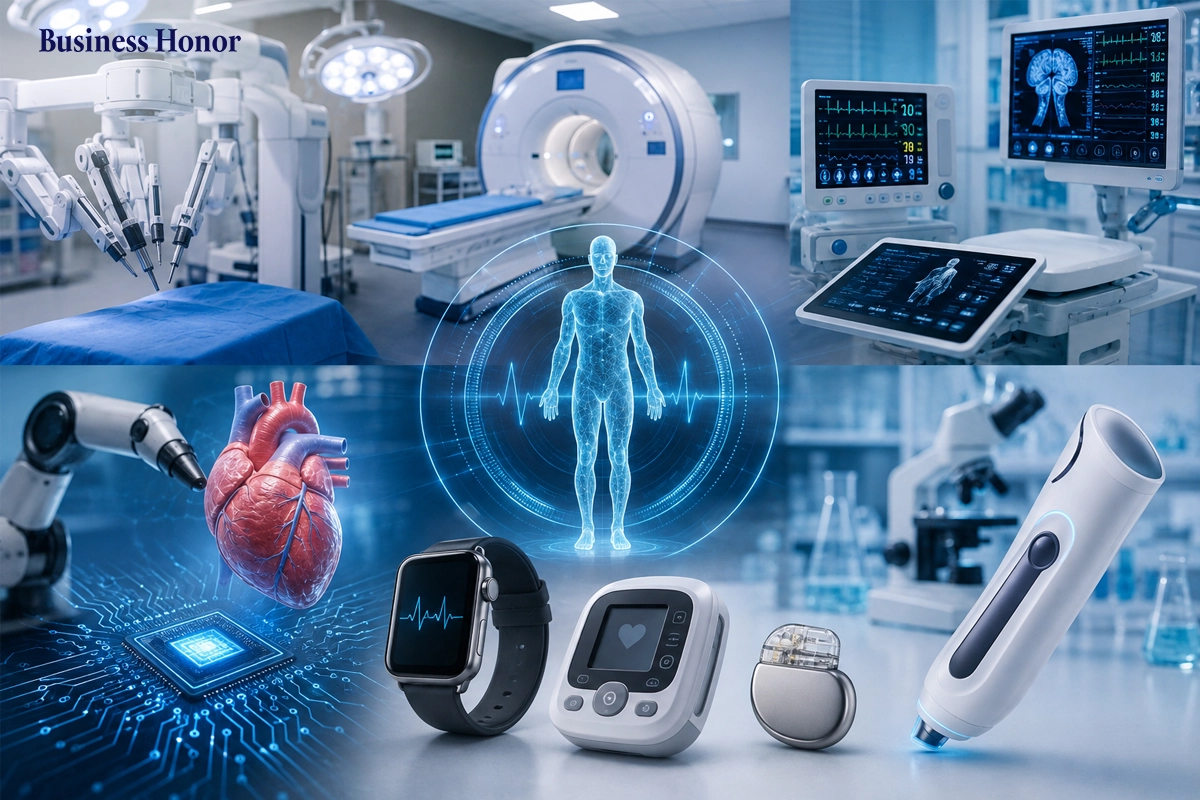
Discover how Top medical device companies 2026 in USA and across global markets are transforming patient care. As healthcare manages supply chain shifts, rising chronic conditions, and rapid AI adoption, business innovation is what sets market leaders apart. Delivering modern patient care requires operational agility, technical vision, and strong regulatory strategy.
To understand where market influence and patient impact are heading, looking at the Future of MedTech offers a clear roadmap. From AI imaging platforms and advanced heart treatments to brain-computer interfaces and surgical robotics, these companies are shaping how modern care is delivered.
Business Honor highlights the Top 20 medtech Companies spanning global market leaders and fast-growing Medical Device startups detailing their core focus, executive leadership, technological breakthroughs, and strategic execution for 2026.
Top 20 Medical Device Companies to Watch in 2026
1. Medtronic, CEO - Geoff Martha: Accelerating Full-Stack Clinical Engineering
Medtronic continues to lead global medical technology revenue, executing a massive pivot toward AI Medical Devices and targeted electrophysiology platforms. With the rollout of its PulseSelect Pulsed-Field Ablation (PFA) system and continuous enhancements to its Hugo robotic-assisted surgery (RAS) ecosystem, Medtronic exemplifies enterprise scale matched with clinical precision.
What to watch in Medtronic's leadership:
- PFA and Cardiac Expansion: Accelerating adoption in electrophysiology and structural heart therapies.
- Surgical Robotics Scale: Expanding the global footprint of the Hugo system into multimodality care.
- Portfolio Optimization: Executing strategic divestitures to double down on high-margin cardiovascular and surgical technologies.
2. Johnson & Johnson MedTech, CEO - Joaquin Duato: Pushing Next-Gen Surgical Robotics
Johnson & Johnson MedTech remains a dominant titan among medical device companies 2026 in USA. Building on its acquisition of Shockwave Medical and significant R&D investments, J&J is advancing its Ottava soft-tissue robotic platform to challenge legacy systems in minimally invasive surgery.
What to watch in J&J MedTech's leadership:
- Ottava Robotic Submission: Navigating regulatory clearance for its long-awaited robotic platform.
- Intravascular Lithotripsy (IVL): Driving the global expansion of acoustic shockwave treatment for calcified arterial plaque.
- Orthopedic Transformation: Modernizing joint reconstruction ecosystems with connected digital tools.
3. Abbott Laboratories, CEO - Robert B. Ford: Dominating Continuous Monitoring & Structural Heart Care
Abbott’s medtech strategy centers on empowering patients and clinicians through continuous data collection. Led by its industry-defining FreeStyle Libre platform and structural heart portfolio (including MitraClip and TriClip), Abbott sits at the heart of decentralized chronic care.
What to watch in Abbott's leadership:
- CGM Ecosystem Growth: Integrating glucose sensing into broader consumer health and metabolic platforms.
- Structural Heart Innovations: Expanding catheter-based valve repair technologies globally.
- Connected Diagnostics: Linking point-of-care diagnostics directly to cloud-based hospital EHRs.
4. Siemens Healthineers, CEO - Bernd Montag: Leading the AI Healthcare Revolution in Diagnostic Imaging
As a pioneer in medical imaging (MRI, CT) and enterprise IT, Siemens Healthineers is fundamentally driving the AI healthcare revolution. By embedding real-time predictive algorithms directly into imaging hardware, Siemens minimizes scan times while improving diagnostic accuracy.
What to watch in Siemens Healthineers' leadership:
- Embedded Machine Learning: Delivering AI-assisted diagnostic image interpretation at the hardware level.
- Theranostics & Molecular Imaging: Expanding precision oncology tools for targeted treatments.
- Enterprise Health IT: Unifying imaging data to streamline hospital workflow management.
5. Stryker, CEO - Kevin Lobo: Redefining Orthopedic Surgery with Digital Ecosystems
Stryker’s relentless focus on surgical innovation and orthopedic robotics has positioned it as one of the fastest-growing market leaders. Its Mako robotic-assisted surgery platform continues to gain dominant market share across hospital and Ambulatory Surgery Center (ASC) settings.
What to watch in Stryker's leadership:
- ASC Market Penetration: Deploying lightweight, specialized surgical equipment to outpatient surgery centers.
- Mako Platform Upgrades: Expanding robotic surgery capabilities into complex shoulder and spine procedures.
- Smart Surgical Instruments: Enhancing power tools with real-time feedback sensors.
6. Boston Scientific, CEO - Mike Mahoney: High-Growth Cardiovascular Innovation
Boston Scientific has outperformed broader medtech market trends through aggressive innovation in interventional cardiology and electrophysiology. Its FARAPULSE PFA system has transformed cardiac ablation procedures, establishing a major competitive moat.
What to watch in Boston Scientific's leadership:
- FARAPULSE Market Dominance: Driving rapid clinical adoption that replaces traditional thermal ablation.
- Neuromodulation Expansion: Leveraging bioelectric therapies for chronic pain management.
- Structural Heart Interventions: Advancing minimally invasive left atrial appendage closure technologies.
7. GE HealthCare, CEO - Peter Arduini: Precision Care via Connected Ultrasound & AI
Since its successful corporate spin-off, GE HealthCare has prioritized precision health by combining medical imaging, contrast agents, and cloud computing. Its focus on portable ultrasound and intelligent workflows aids rapid point-of-care decision-making.
What to watch in GE HealthCare's leadership:
- CareIntellect Applications: Deploying clinical decision-support AI tools directly to bedside providers.
- Handheld Ultrasound Scaling: Broadening access to point-of-care imaging across rural and emergency settings.
- Theranostics Integration: Pairing diagnostic imaging with targeted radioisotope therapies.
8. Intuitive Surgical, CEO - Dave Rosa: Defending the Frontier of Surgical Robotics
Intuitive Surgical created the robotic-assisted surgery market and continues to define its future with the rollout of the da Vinci 5 platform. Featuring advanced force-sensing technology and unmatched computational power, Intuitive retains a strong competitive advantage under CEO Dave Rosa.
What to watch in Intuitive's leadership:
- da Vinci 5 Commercial Expansion: Upgrading existing hospital footprints to its most advanced system.
- Ion Endoluminal System: Scaling flexible robotic bronchoscopy for early-stage lung cancer detection.
- Data & Analytics Integration: Utilizing surgical video feeds to provide AI-driven feedback to surgical teams.
9. Becton Dickinson, CEO - Tom Polen: Essential Infrastructure for Global Health
Becton Dickinson operates as the backbone of global medical delivery, manufacturing critical diagnostic tools, drug administration systems, and vascular access devices. BD’s leadership prioritizes supply chain resilience, automated medication management, and hospital workflow automation.
What to watch in BD's leadership:
- Smart Infusion Pumps: Upgrading cybersecurity and connected software across infusion management systems.
- Biosciences & Diagnostics: Expanding automated molecular testing tools in clinical laboratories.
- Surgical & Peripheral Vascular Tools: Driving growth through specialized vascular repair technologies.
10. Philips Healthcare, CEO - Roy Jakobs: Connected Care and Image-Guided Therapy
Fully dedicated to health technology, Philips focuses on connected patient monitoring, enterprise telehealth, and minimally invasive image-guided therapy systems.
What to watch in Philips' leadership:
- Azurion Platform Adoption: Enhancing interventional suites with integrated image-guided therapy workflows.
- Remote Patient Monitoring: Connecting hospital ICUs directly with home-based patient monitoring networks.
- Device Cybersecurity: Establishing high standards for connected medical device security.
11. Synchron, CEO - Thomas Oxley: Pioneering Endovascular Brain-Computer Interfaces
Synchron stands at the forefront of neural interface engineering with its Stentrode brain-computer interface system. Implanted through the neurovascular system without requiring open brain surgery, Synchron offers a safer, less invasive pathway to restore digital autonomy for paralyzed patients.
What to watch in Synchron's leadership:
- Pivotal Clinical Trials: Advancing human trial registries toward FDA commercial approval.
- Endovascular Delivery Advantage: Maintaining a distinct surgical safety edge over open-skull BCI competitors.
- Digital Interface Ecosystem: Expanding hands-free operating software capabilities for Apple and Android platforms.
12. CMR Surgical, CEO - Massimiliano Colella: Scaling Modular Surgical Robotics Globally
CMR Surgical is challenging heavy legacy robotic systems with Versius, its flexible, portable surgical platform. Versius features individual modular arms that easily fit into standard operating rooms, bringing robotic surgery capabilities to high-volume community hospitals worldwide.
What to watch in CMR Surgical's leadership:
- Global Market Expansion: Penetrating key hospital systems across Europe, Asia, and Latin America.
- Versius Ecosystem Upgrades: Integrating advanced clinical visualization and telemetry into surgical suites.
- Outpatient & ASC Adoption: Positioning its platform as an affordable alternative for ambulatory surgical centers.
13. BiVacor, CEO - Jim Dillon: Reimagining Total Artificial Hearts with Magnetic Levitation
BiVacor is breaking new ground in heart failure treatment with its titanium, magnetically levitated rotary pump total artificial heart. Designed to completely replace both ventricles, its single moving part significantly reduces mechanical friction and blood cell damage.
What to watch in BiVacor's leadership:
- Early Feasibility Human Studies: Demonstrating safety and efficacy in critical bridge-to-transplant trials.
- Durability Engineering: Proving long-term wear reduction through magnetic levitation technology.
- Cardiovascular Market Positioning: Addressing the severe global shortage of donor hearts.
14. EvoEndo, CEO - Jonathan T. Hartmann: Transforming Unsedated Gastrointestinal Care
EvoEndo is revolutionizing upper gastrointestinal diagnostics with its 3.5mm flexible gastroscope. Delivered transnasally without general anesthesia or conscious sedation, EvoEndo drastically reduces procedure time, clinical footprint, and recovery hazards.
What to watch in EvoEndo's leadership:
- Pediatric & Adult Adoption: Expanding adoption across gastroenterology centers seeking safer diagnostics.
- Procedure Cost Reduction: Eliminating anesthesiologist and recovery-room overhead for hospital systems.
- Outpatient Clinic Migration: Moving routine GI evaluations from hospital suites directly to outpatient settings.
15. HemoSonics, CEO - Bob Roda: Advancing Real-Time Point-of-Care Coagulation Testing
HemoSonics, a medical technology firm specializing in acute care diagnostics, manufactures the Quantra Hemostasis System. Quantra uses sonic technology to measure blood clot stiffness directly in the operating room, delivering critical bleeding diagnostic data in minutes.
What to watch in HemoSonics' leadership:
- OR & Trauma ICU Integration: Expanding placement across cardiovascular surgery and critical care units.
- Targeted Blood Management: Reducing unnecessary blood product transfusions during major surgical cases.
- Quantra Cartridge Pipeline: Broadening assay menus for specialized coagulopathy detection.
16. Healthy.io, CEO - Yonatan Adiri: Converting Smartphone Cameras into Clinical Tools
Healthy.io turns everyday smartphone cameras into clinical-grade medical scanners for home urine testing and chronic wound tracking. By leveraging computer vision and machine learning algorithms, Healthy.io delivers clinical diagnostics straight to the patient's home.
What to watch in Healthy.io's leadership:
- Chronic Kidney Disease Screening: Scaling home-based albumin-to-creatinine testing with major health plans.
- Digital Wound Management: Expanding camera-based 3D wound assessment tools for home healthcare nurses.
- Payer & Health System Partnerships: Demonstrating early disease detection savings for large health insurers.
17. Flow Neuroscience, CEO - Erin Lee: Modernizing Non-Invasive Brain Stimulation for Mental Health
Flow Neuroscience offers the first medically approved at-home treatment for depression that combines non-invasive brain stimulation with behavioral therapy. Its headset delivers Transcranial Direct Current Stimulation (tDCS) to restore activity in the left frontal lobe.
What to watch in Flow Neuroscience's leadership:
- US Market Commercial Rollout: Executing a planned commercial expansion into the United States.
- Clinical Trial Pipeline: Expanding indications beyond depression to include bipolar disorder and addiction.
- Antidepressant Alternative Adoption: Positioning tDCS wearables as medication-free primary treatments.
18. Francis Medical, CEO - Mike Kujak: Targeting Prostate Cancer via Water-Vapor Ablation
Francis Medical is developing Vanquish, a water-vapor ablation system designed to treat prostate cancer precisely. Using the thermal energy stored in sterile water vapor, the technology destroys cancerous tissue without damaging surrounding delicate structures.
What to watch in Francis Medical's leadership:
- FDA Clinical Approvals: Navigating pivotal clinical trials toward pre-market authorization.
- Side-Effect Mitigation: Preserving urinary and erectile function compared to radical prostatectomies.
- Urology Market Strategy: Leveraging executive expertise in water-vapor therapy to achieve rapid hospital uptake.
19. Enable Injections, CEO - Mike Hooven: Revolutionizing Wearable Subcutaneous Drug Delivery
Enable Injections designs and manufactures the enFuse body-worn drug delivery system. The platform allows patients to self-administer high-volume, high-viscosity biologic medications subcutaneously at home, replacing traditional hours-long IV infusions.
What to watch in Enable Injections' leadership:
- Pharma Partner Pipeline: Expanding co-development agreements with top global biopharmaceutical firms.
- At-Home Biologic Shift: Moving complex oncology and autoimmune drug delivery outside the hospital clinic.
- Patient-Centric Engineering: Improving compliance with comfortable, automated, hands-free infusion devices.
20. CergenX, CEO - Jason Mowles: Screening Newborn Brain Health with AI Algorithms
CergenX is an Irish medtech innovator using artificial intelligence to screen newborn infants for brain injuries within minutes of birth. Its algorithms analyze short EEG brainwave recordings to catch hypoxic-ischemic encephalopathy early.
What to watch in CergenX's leadership:
- Device Manufacturer Licensing: Embedding AI diagnostic software into third-party neonatal monitors.
- Neonatal ICU Expansion: Deploying rapid brain screening tools into delivery suites and nurseries worldwide.
- Proprietary Databank Expansion: Leveraging massive brainwave training data to improve algorithm precision.
Strategic Drivers Reshaping the MedTech Landscape in 2026
The convergence of software platforms, hardware miniaturization, and decentralized care models is driving profound shifts across healthcare systems:
- Integrated AI Workflow Software: Regulators have cleared over 1,000 algorithms for AI Medical Devices, turning software into a core therapeutic component rather than a standalone diagnostic tool.
- De-escalation of Anesthesia & Inpatient Stays: Technologies enabling unsedated endoscopy, remote monitoring, and outpatient robotic surgery are lowering costs while preserving clinical efficacy.
- Cybersecurity as Enterprise Infrastructure: Connected IoMT (Internet of Medical Things) devices require military-grade encryption and secure, continuous software updates to protect patient safety.
The MedTech Organizations Defining 2026
Evaluating the medical device companies 2026 in USA and across global markets highlights, Business Honor Examines that long-term success belongs to companies that translate technological breakthroughs into proven patient outcomes. From established scale at Medtronic and Abbott to pioneering neural platforms from Medical Device startups like Synchron, these Top 20 organizations are actively shaping the future of AI healthcare revolution.












.webp)

.webp)




.webp)


Comments
0 Comments