
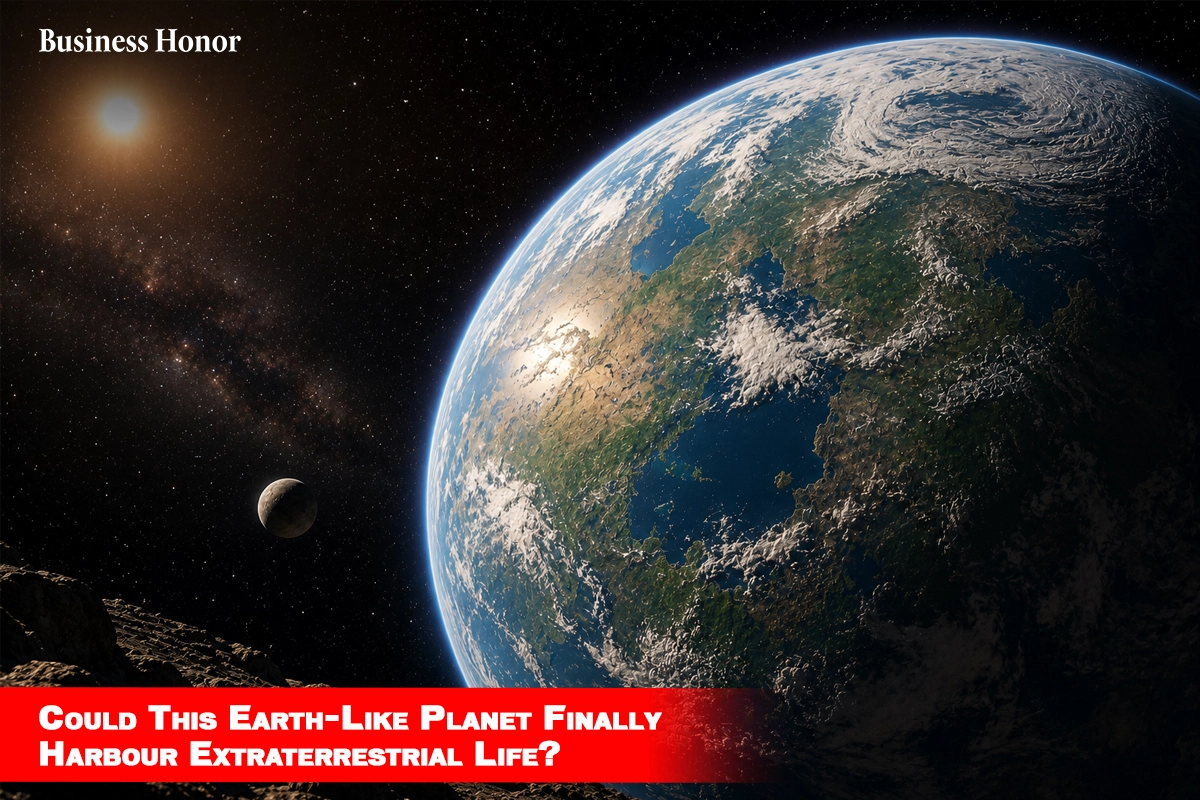
Scientists discover atmosphere around distant Earth-like planet that could support water and potentially sustain life.
|
Space Discovery: Scientists achieved a historic breakthrough in their exploration of life beyond Earth as they discovered the atmosphere located on a distant rocky planet capable of providing the conditions for the appearance of liquid water and life. The planet called LHS 1140b is situated near a red dwarf star, approximately 49 light-years from Earth in the constellation Cetus, meaning that stellar classification and its importance in the field of exoplaneting has reached a high level of development.
This is the first time when astronomers have managed to observe an atmosphere surrounding another rocky exoplanet, namely, a planet located within the habitable zone of its star, which means that there may be conditions for liquid water to exist on its surface. Also, it is the first time when scientists were able to identify the composition of the atmosphere of a solid planet. "By conducting the research, we provide an opportunity for LHS 1140b to be the first and the best planetary object in our research of habitability and astrobiology," Dr. Collin Cherubim, who worked on the research at Harvard University, notes.
LHS 1140b, which was initially discovered in 2017, possesses several characteristics that make it particularly compelling for scientific investigation. The planet has a mass approximately 5.6 times that of Earth and a radius 70 percent larger, yet its overall composition and temperature bear similarities to our home planet. The planet's peculiarities do not end there; LHS 1140b is tidally locked to its parent star, which means that the same side of the planet is always facing the star, possibly has a higher volume of water than Earth, and likely has a different composition of gases in the atmosphere. The characteristics of the parent star favor habitability as well; although the red dwarf is much smaller and dimmer than the Sun, it emits more ionizing radiation. The activity of the star is low, and it produces very rare flares, which decreases the amount of harmful radiation that gets to the surface of the planet.
According to Cherubim, “LHS 1140b possesses all the similar traits needed for habitability. The composition of LHS 1140b is rocky like the Earth, the Earth-Like Planet is in ranges of temperature that allow for the existence of water in liquid form, plus it has an atmosphere that brings a double differentiating function in that it retains water on the planet and protects it from radiation.”
Should previous studies have found atmospheres around gas giant planets and also recognized the atmosphere signatures around rocky planets outside of the habitable zones, this research brings a novel finding confirming the atmosphere on a possibly habitable planet of rocky type. The finding brings new possibilities for telescopic and spectroscopic observations that permit researchers to understand whether the atmosphere of LHS 1140b contains biosignatures or any other signs of life occurrence on the planet.
Business Honor is of the view that the atmospheric discovery on LHS 1140b represents a transformative advancement in exoplanet habitability research capabilities.














.webp)

.webp)




.webp)


Comments
0 Comments