Thursday, October 22, 2026
Business Honor
At PrimaryMD, care is viewed through the lens of the individual instead of the system. Health can be an ongoing relationship that uses history, habits, and long-term goals as touchpoints for establishing health over time, versus symptoms or isolated encounters with the system. By understanding health as something that changes over time, the individual can move away from reactive treatment and into a more fluid, informed process. PrimaryMD has created a framework that organizes care to be less fragmented and confusing than it typically is in the medical system. By providing a cohesive team that provides a consistent flow of information between an individual and their providers, the patient reduce the burden of navigating disconnected services independently. They take into consideration not only the individual’s medical history, but also their lifestyle factors and personal goals to create a more complete picture of their health and wellness.
Having continuity and trust is essential to providing patients and their families a feeling of security through their entire care experience. The use of technology as an integrated part of the model for care enables accurate tracking of patient health information, improved communication with their healthcare providers, and the ability to provide timely interventions as needed. Each of the steps within the PrimaryMD process focuses on maintaining clarity, continuity, and flexibility through a consistent approach spanning from discovery through long-term planning. Instead of conceiving of healthcare as a series of disconnected interventions, PrimaryMD's vision is to define healthcare as a journey.
Healthcare Processes Offered by PrimaryMD
Health Discovery
The Discovery of Health phase creates an in-depth understanding of an individual prior to any formal evaluation beginning. This phase expands on the normal intake process of using traditional medical question forms to include collection of information around the person's own experiences, behavioral patterns, and long-term concerns. To ensure a deeper understanding of the person and how they fit into the context of the decisions made regarding their health, this phase gathers information beyond just surface-level or statistical types. This phase of collecting and organizing medical records enables a continuous history of the person by providing the ability to view previous diagnoses, treatments, and outcomes as a single continuum and not as separate, fragmented events.
A dedicated care-team member is involved in the individual's care from the beginning of their relationship with the healthcare system, thus establishing continuity from the outset. Instead of introducing a different provider each time an individual sees a provider, they will have the same providers throughout their care journey, allowing them to build a relationship as the care team learns about them over time. This type of continuity enables the accumulation of a large amount of information and helps to minimize the need for redundant record keeping and documentation that typically occurs in traditional healthcare settings.
The Discovery phase will also provide a foundation for a more humane, collaborative approach to healthcare by focusing on the patient or individual as a human being, listening, and understanding, before making any clinical interventions. Individuals will have the opportunity to discuss their medical issues as well as their reasons for their symptoms, what they are afraid of, and what their expectations are concerning their health. This broader perspective provides members of the care team with insights into potential cases or patterns, which often would not be able to be discovered using traditional healthcare systems.
Comprehensive Assessment
In this second phase, PrimaryMD takes all of the data gathered from the discovery phase and puts it into a format that they can use to assess the patient’s health in a quantifiable manner. They discuss current health through use of different assessments and diagnostic tools and then develop measurable benchmarks for the individual’s health based on both observable and non-observable factors. Each assessment includes several different types of tests that will help determine the overall physical wellness in a non-acute manner. In addition, when they conduct the assessments, they do not conduct them with a narrow focus (meaning just looking at only the reason for concern); rather, they look at many different indicators that may identify patterns and possible future issues that the individual cannot currently identify yet.
Once they take all of the individual’s health assessment data, PrimaryMD evaluates how those results correlate to the present state of health and uses those findings to develop a more complete picture of the physical condition. They assess every single test on behalf of a client to see if it can be analyzed by someone without clinical knowledge and provide the basic health data in a way that anyone can comprehend it without having had a formal education in medicine or healthcare. They show the average Joe how complicated it is to take data that was collected and turn it into useful health information that can be used to make informed decisions about health and wellness.
The purpose of this phase is to analyze the data that was collected; however, this phase also puts emphasis on interpreting the data and providing context to the data. The care team identifies relationships between the data points of various systems in the body to identify potential developing health trends. For instance, when one looks at minor differences in biomarkers collected, looked at collectively, one may see early signs of an issue that could have gone unnoticed. Presenting the findings in a way that is concise and highly relatable empowers the individual to engage with the data regarding their health. Using visuals, simplified summaries, and guided explanations will help ensure the information is not overwhelming but will lead to actionable results. The primary goal of PrimaryMD's integrated and comprehensive approach is to provide an opportunity for individuals to have a more complete picture of their overall wellness rather than just by isolated measurements.
Expert Consultation
The Expert Consultation phase takes all the information gathered and forms a discussion. This phase takes place between the person receiving care and their clinical team (doctor, nurse, etc.), where all the findings from earlier phases are reviewed, discussed, and understood in detail. The main focus of this phase is on understanding rather than just reporting results. This phase of the consultation process allows the individual to ask questions, seek clarification, and reflect upon each piece of information. The care team looks at how the diagnostic information connects with the individual’s life like daily activities, habits, and long-term concerns.
All pieces of data are considered parts of the broader context of the individual as described in the Discovery Phase that allows clinicians' interpretation of data to stay relevant to the lives of their clients. The Consultation phase adds an element of collaboration to the delivery of care, whereby clients become active participants in their own health care experience rather than simply receiving information. Conversation can extend beyond the clinical data to include information about healthy eating, physical activity, and preferences.
Additionally, the Consultation Phase helps to build the relationship between the individual and the health care team through creating a culture of communication and trust. The Consultation phase creates a safe space in which clients feel free to speak openly about issues that may not come up in a typical medical setting. The result of this collaborative interaction is a set of recommendations that are evidence-based and feasible within the context of day-to-day living. The process of aligning expertise within the clinical domain with the personal domain of values and goals creates an atmosphere for shared decision-making reducing anxiety and increasing confidence regarding the path ahead.
Personalized Care Plan
The Personalized Care Plan builds on previous stages and is a means to leverage the knowledge gained from previous phases into a systematic way forward. The PCAP is not intended to be a rigid, prescriptive plan but instead an evolving framework that can adjust with any changes in an individual's health status, circumstances or priorities. The ongoing evolution of the PCAP will make it applicable for continued use and not become irrelevant as circumstances change. The PCAP is created to combine the medical findings and other facets of the individual's life into a comprehensive strategy to address both short-term and long-term objectives. The individual's own preferences, baseline data, and the results from consultations all shape the recommendations of the PCAP to maintain an individualized approach rather than a generalized one. New data will guide how the PCAP changes and thereby how it adjusts to support the individual as he or she makes progress.
Underlying these changes is a recognition that health is an ongoing process and requires continuous surveillance for changes in order to maintain the same level of health. The PCAP is thus not only about treatments but also includes preventive and long-term or maintenance aspects. Relatedly, the PCAP constitutes a living document that can be modified as the individual develops and, therefore, can remain relevant throughout his/her life. The Personalized Care Plan will employ feedback loops to allow for regular evaluation of the individual’s progress and subsequent modification of the PCAP based upon those evaluations, preferences, and additional health information.
Consequently, the adaptability of the Personalized Care Plan helps the individual to remain engaged and active in his/her own care by enabling them to assess the results of his/her contributions toward improving the patient’s health. The Personalized Care Plan will also incorporate prevention strategies, including behavioral changes, routine screenings, and wellness-related practices to mitigate the risk of developing future illnesses. The combination of clinical-based recommendations and everyday practical actions will create a bridge between physicians’ recommendations and actual implementation in the patient’s life.
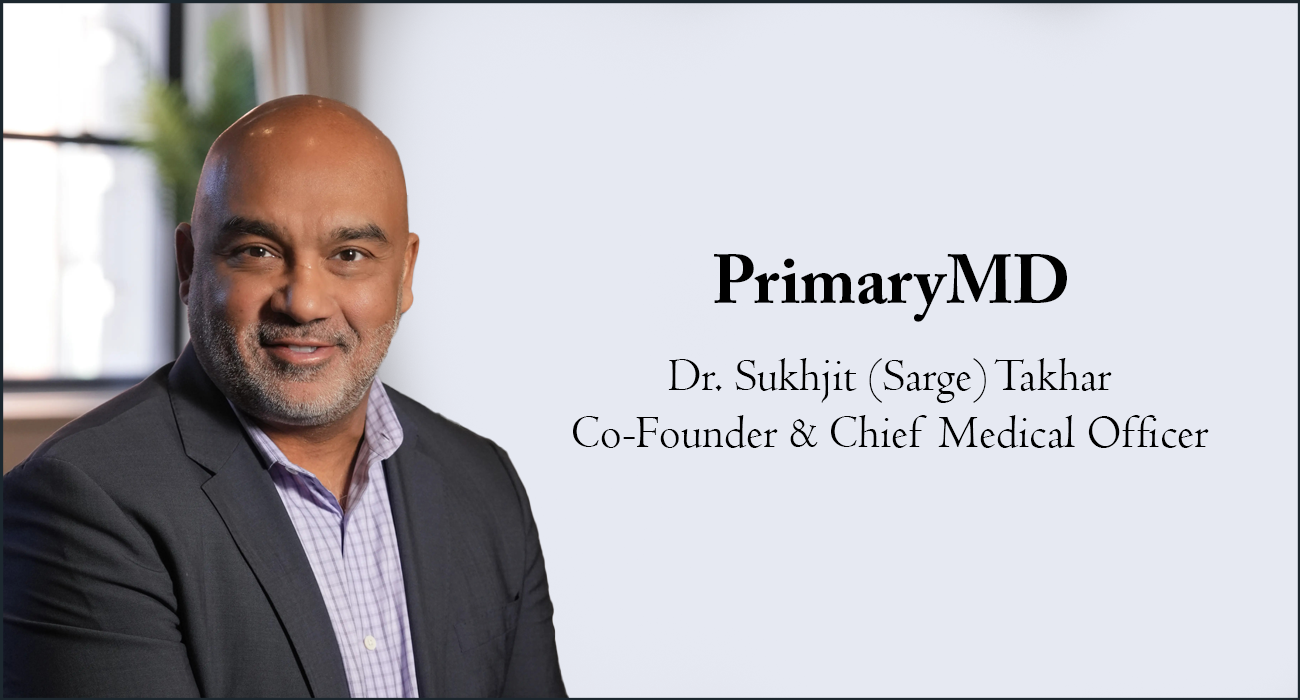
Dr. Sukhjit (Sarge) Takhar | Co-Founder & Chief Medical Officer
Dr. Sukhjit Takhar is the Co-Founder & Chief Medical Officer of PrimaryMD. Dr. Takhar is a distinguished physician and the Co-Founder & Medical Director of PrimaryMD, dedicated to personalized primary care, infectious diseases, and longevity medicine. With over two decades of experience in internal medicine, infectious disease management, and clinical innovation, Dr. Takhar integrates evidence-based medicine with cutting-edge technologies.































.webp)
.webp)



.webp)