
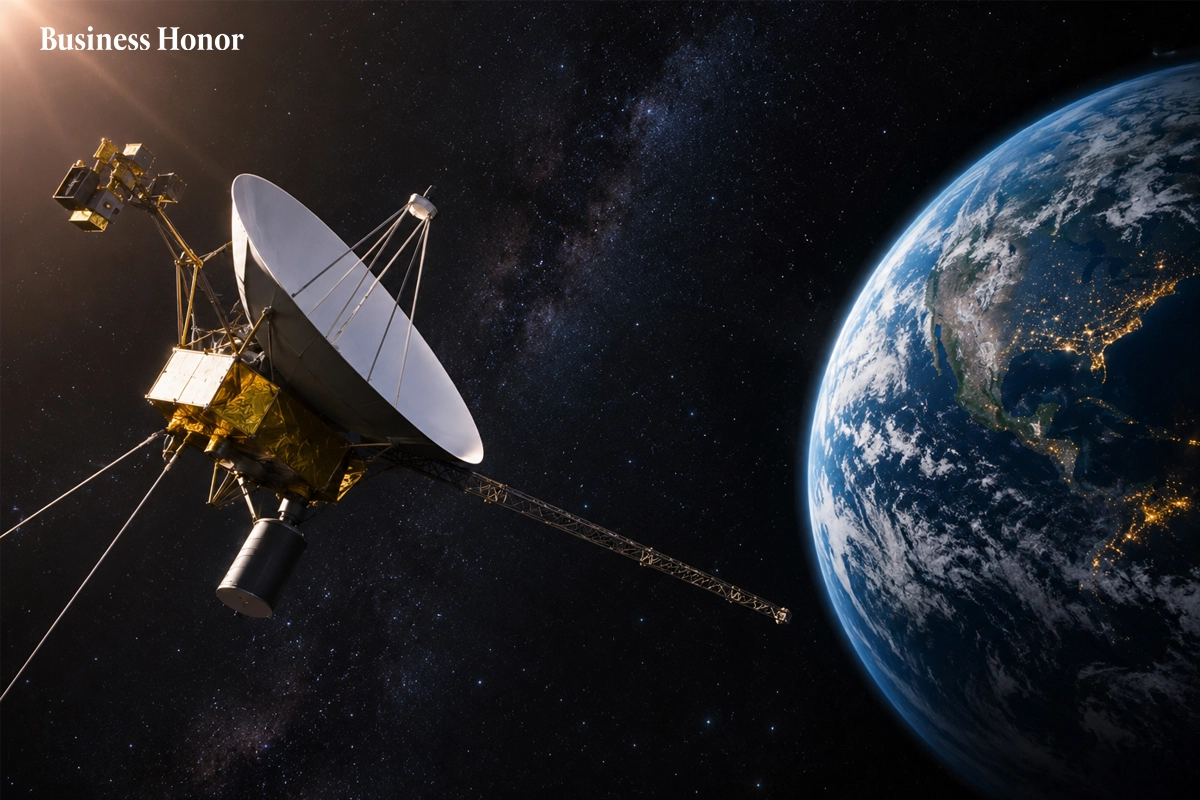
NASA’s Voyager 1 has reached a historic distance of one light-day from Earth, marking another remarkable milestone in nearly five decades of space exploration.
|
This is a rare moment in space exploration. Voyager 1 has just reached one light-day from Earth. At this distance, light takes 24 hours to travel from the spacecraft to Earth. That is how far Voyager 1 is from Earth.
According to Space & Defense, Voyager 1 has been sending back signals to NASA but has not been transmitting science and engineering data since November 14th 2026. Although a carrier signal is being sent back from the spacecraft, no data is being transmitted. Engineers at NASA are working to find out what has gone wrong.
Voyager 1 has travelled more than 15 billion miles, taking it far beyond the outer planets and into interstellar space. This NASA Voyager 1 historic milestone in interstellar space gives scientists a rare opportunity to study conditions beyond the Sun's influence.
“Voyager 1 crossing the light-day threshold is yet another historic feat on an extraordinary voyage of discovery,” said Dave Gallagher, Director of NASA's Jet Propulsion Laboratory (JPL).
It takes just under a day for a signal to travel one way between Earth and Voyager 1. This means that it takes about 24 hours for a signal to reach Voyager 1 from Earth and another 24 hours for a reply to return, meaning NASA engineers have to wait almost two days for a response.
Voyager 1 has made its way into interstellar space. Interstellar space lies outside the "bubble" of the solar system called the heliosphere. This bubble is formed by the solar wind and magnetic field from the Sun. In 2012, Voyager 1 left the outer edge of the heliosphere and entered interstellar space. Since then, it has been exposed to conditions that are not dominated by the Sun’s solar wind.
Voyager 1 launched in 1977, and over almost five decades, it has provided useful data for scientists. It has given us information on Jupiter and Saturn and their moons, rings, and atmospheres. Observations have allowed scientists to understand these faraway planets in greater detail.
Business Honor observes that Voyager 1's long journey shows what decades of space research can achieve.
FAQs
1. What is the one-light-day milestone achieved by Voyager 1?
Voyager 1 has reached a distance from Earth that light takes approximately 24 hours to cross. This means radio signals also need about a day to travel between Earth and the spacecraft in one direction.
2. How far is Voyager 1 from Earth?
Voyager 1 is approximately 16.1 billion miles from Earth, making it the most distant human-made spacecraft.
3. When did NASA launch Voyager 1?
NASA launched Voyager 1 on September 5, 1977, to study the outer planets of our solar system. Its mission later took it into interstellar space.
4. Is Voyager 1 still operating in space?
Yes. Voyager 1 continues its journey through interstellar space. However, the spacecraft has faced technical and communication problems as its systems age.
5. Why is Voyager 1 important for space exploration?
Voyager 1 has provided valuable information about Jupiter, Saturn, and interstellar space. Its discoveries have helped scientists understand distant planets and the region beyond the Sun's influence.














































.webp)


.webp)



Comments
0 Comments