
The history of India is filled with tales of abandoned villages, strange geological formations, ancient rock art, and monuments surrounded by stories. Some of these mysteries have scientific explanations, whereas others leave us wondering. Such mysterious spots in India connect us with the rich history, fascinating folklore, and mysteries. They collectively take us across different eras and parts of the country. For travellers interested in mysterious historical places to visit in India, these destinations offer a closer look at the country's unusual past. They also attract people searching for unexplained places in India with historical significance.
This is not an official ranking. These ten sites explore the ancient mysteries of India. Mysterious does not always mean supernatural; evidence matters. Business Honor highlights these destinations as examples of how India's historical sites continue to attract interest through their unique stories, archaeological value, and cultural significance.
- Bhangarh Fort, Rajasthan
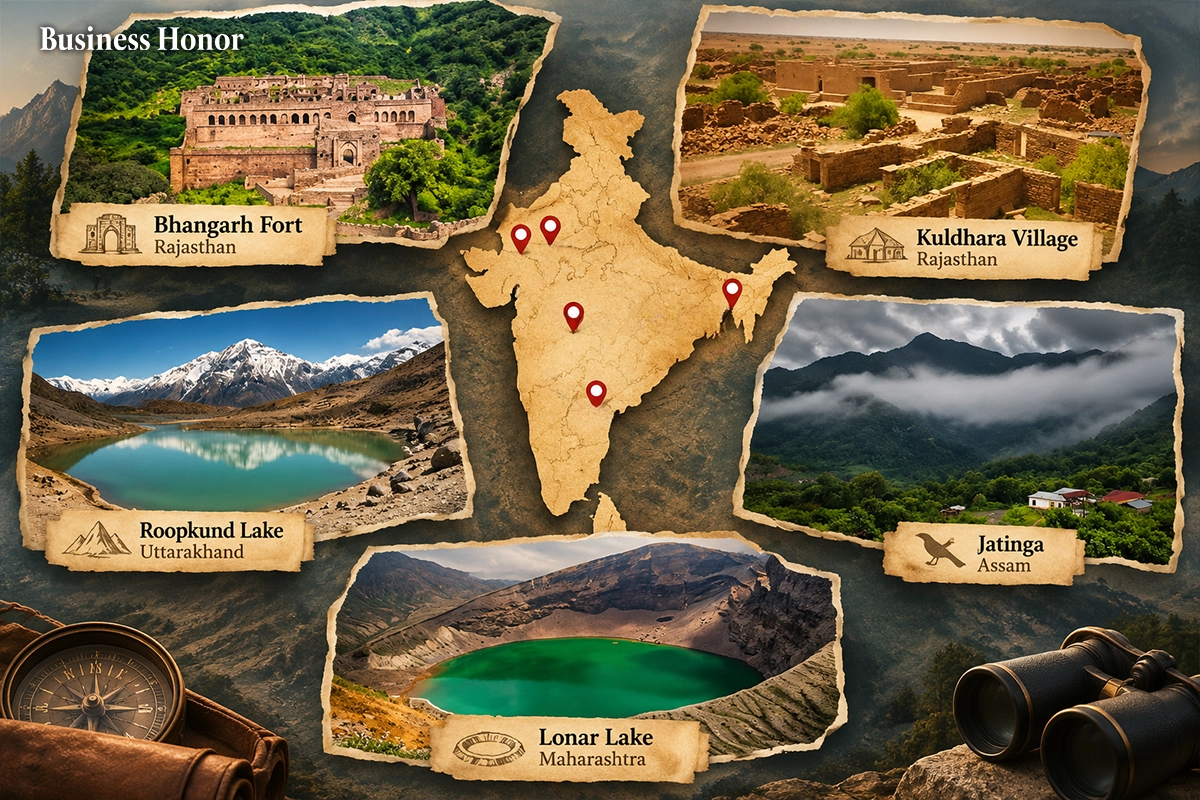
Bhangarh Fort in Alwar, Rajasthan, is one of those places that have stories about curses and hauntings attached to it. This fort can be traced back to the 17th century and is associated with Madho Singh. Its ruins consist of palaces, temples, and gateways. A curse is believed to be responsible for its downfall, but nothing paranormal has been proven yet. The Archaeological Survey of India restricts entry after sunset. Bhangarh Fort’s ruins have made it become one of India’s most haunted forts.
- Kuldhara Village, Rajasthan
Approximately 17 kilometres away from Jaisalmer lies an abandoned village named Kuldhara, which was originally built by the Brahmin community known as the Paliwals. According to information from Rajasthan Tourism, this village was built in 1291, and its residents vacated it in 1825 along with those of other surrounding villages. One story links the departure to a minister’s demands, while another claims that the people cursed the town. The reasons are unknown. Kuldhara is a historical place with its ruins of houses and streets, not a source of supernatural stories.
- Roopkund Lake, Uttarakhand
Roopkund is located above 5,000 metres in the Himalayan range and is popularly referred to as Skeleton Lake because human bones were discovered in the area surrounding the lake. The study published in Nature Communications in 2019 focused on the DNA extracted from 38 people. These remains had South Asian and eastern Mediterranean ancestry. The dating process proved that the people did not perish in a single incident leaving Roopkund an intriguing archaeological mystery.
- Jatinga, Assam
Jatinga is a small town in the Dima Hasao district of Assam that witnesses a peculiar migration of birds referred to as the phenomenon of bird “suicide.” According to Assam Tourism, the birds tend to be lured by lights in houses due to certain weather patterns, which bring them down near residential areas, where they may be killed. This happens during the months of September to November.
- Lonar Lake, Maharashtra
Lonar Lake lies inside a crater found in the Deccan basalt formation of Maharashtra. The circular nature of this crater has led scientists to consider a volcanic cause. However, studies have shown that Lonar Lake was formed due to the impact of a meteorite. NASA has calculated that the meteor impact occurred between 35,000 and 50,000 years ago.
- Lepakshi Temple, Andhra Pradesh
The Veerabhadra Temple, built in the 16th century at Lepakshi, is famous for its paintings from the Vijayanagara period and its hanging pillars. The hanging pillar leaves a space under its base through which a thin object can be passed. This raises questions about the engineering skills of the temple’s builders. The temple also contains murals and an unfinished Kalyana Mandapa. Inscriptions provide evidence of the temple’s history.
- Unakoti, Tripura
Unakoti is an archaeological site that contains massive images carved into rocks, particularly those of Lord Shiva. According to the description on UNESCO’s tentative list, most of the sculptures date back to the 8th and 9th centuries. Its name translates to “one less than a crore.” Local legend says the carvings represent deities turned to stone after failing to wake before sunrise. Its patrons and carving stages remain uncertain, making it one of India’s unexplained historical places.
- Shaniwar Wada, Maharashtra
Construction of Shaniwar Wada in Pune was started by Peshwa Bajirao I during the 18th century. The structure was partially destroyed by fire in 1828. It has a connection with the killing of Peshwa Narayanrao in 1773. There are stories of a spirit screaming at that place, although these remain legendary. Its violent past explains its reputation among haunted historical places in India.
- Barabar Caves, Bihar
The Barabar Hills boast some of the earliest rock-cut caves in India, which date back to the Mauryan era in the third century BCE. According to the inscriptions found inside them, the caves are associated with King Ashoka and his successor Dasharatha, who dedicated them to the ascetic order of Ajivika.
- Vittala Temple, Hampi, Karnataka
The Vittala Temple complex in Hampi is known for its stone chariot and musical pillars. This complex was constructed during the reign of the rulers of the Vijayanagara Empire. According to mysteries, the musical pillars in this temple produce musical notes when tapped. However, visitors are not supposed to tap these pillars because it is a protected monument. In 1565, the city of Hampi was attacked and looted.
Why These Places Continue to Fascinate
From the discoveries in Roopkund to the sculptures in Unakoti, these places demonstrate how archaeology, science, architecture, and folklore help create mysteries. Some mysteries have been explained through research, while others continue to remain part of India’s past. These destinations also offer a glimpse into the beliefs, traditions, and architectural skills of earlier generations. Whether it is an abandoned village, an ancient temple, or an unusual natural formation, each place has a story that attracts historians, researchers, and travellers. Their history and legends continue to make India's heritage fascinating and worth exploring.














































.webp)


.webp)



Comments
0 Comments