
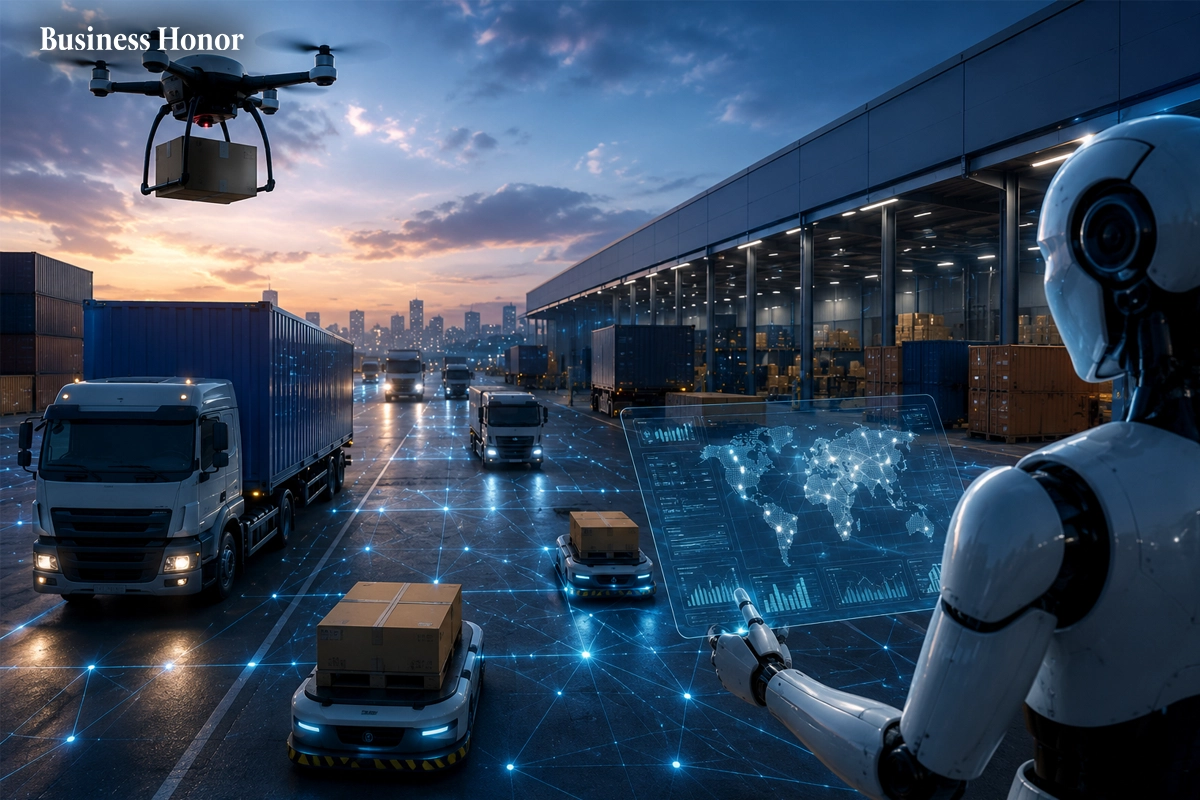
Supply chain and logistics have become increasingly dependent on data analysis due to the complexity of the transport network, fluctuating demand, labor issues, inventory needs, and consumer expectations. In this regard, artificial intelligence is gaining ground as a key tool for analyzing such data and assisting in making quick decisions.
AI in Modern Logistics & Supply Chains is changing how organizations forecast demand, plan transportation, manage warehouses, monitor shipments, and identify potential disruptions. Logistics capacity providers in 2026 are also adopting these technologies to improve network visibility, capacity utilization, and operational responsiveness.
From transportation providers to manufacturers, retailers, and logistics companies, the adoption of AI is creating opportunities to make supply chains more responsive and resilient.
How AI Is Transforming Logistics
AI in Logistics Planning
One of the most proven uses of AI in logistics is planning. In logistics, one needs to plan the route, vehicle, driver, schedule, warehouse, and customer needs.
AI can use massive amounts of data, either past or current, to detect trends and suggest better routes or scheduling. This can help in dealing with changes in traffic, deliveries, weather, and other factors.
Route optimization also results in reduced miles driven, but this again depends on the quality of data used.
AI in Supply Chain Management
AI in supply chain management can support demand forecasting, inventory planning, supplier analysis, procurement, and risk management.
Forecasting traditionally tends to depend extensively on the historical sales data of the company. However, through AI, historical data can be analyzed along with many other factors, such as market environment, seasonality, promotions, and other operational data.
Effective forecasting helps businesses to avoid stock overages and shortages. It also allows companies to spot possible disruptions and come up with other solutions.
AI-Powered Demand Forecasting
Demand forecasting is one of the biggest challenges in supply chain management.
Using AI algorithms, big datasets can be analyzed, and relationships can be found that would not have been possible to find using traditional methods. Companies, such as retailers, manufacturers, and distributors, can use these findings to forecast future demand and optimize inventories.
For instance, AI could be used by a company to identify seasonal patterns in demand and predict any changes before it becomes noticeable using traditional reporting.
Nevertheless, AI forecasts will be no better than the data, assumptions, and models that are behind them. In some cases, especially where markets are experiencing abnormal activity, human analysis still plays a significant role.
Smarter Warehouse Operations
There are other areas in which AI in logistics is opening up new possibilities.
These include inventory management, warehouse slotting, demand-driven replenishment, and automated picking systems. With the integration of robotics and computer vision, AI will be able to assist machines in recognizing products, moving through facilities, and performing repetitive tasks.
With the help of AI, warehouse management will be able to decide on the positioning of products, taking into account such things as their demand rate and mobility.
The integration of all these technologies is leading to more automated distribution centers.
Route Optimization and Transportation
Transportation forms an important component of logistics expenses; therefore, route optimization becomes increasingly important.
AI is capable of studying delivery destinations, the carrying capacity of vehicles, traffic details, delivery time windows, and past transportation records to suggest appropriate routes.
Dynamic routing can also enable logistics providers to alter their plans based on changes in conditions. For instance, delivery routes can be altered in case of congestion or any problem with the vehicle.
This will increase the efficiency of the fleet as well as provide greater visibility for deliveries.
AI and Customer Experience
The effects of artificial intelligence go beyond the internal workings of logistics operations.
There is a growing expectation of precise estimates of delivery times, real-time tracking, choice of delivery methods, and quick replies to queries.
Artificial intelligence can be used to track shipments and send updates automatically. Artificial intelligence chatbots and virtual assistants can help in answering basic queries related to logistics.
Visibility and communications may result in a more predictable customer experience.
Challenges of AI Adoption in Logistics
Despite its potential, AI adoption presents several challenges.
Data Quality
AI requires reliable and appropriately structured data. Inconsistent information across logistics systems can reduce the quality of AI-generated recommendations.
Integration
Organizations may operate multiple legacy transportation, warehouse, enterprise-resource-planning, and supply chain systems. Integrating AI with these environments can be complex.
Cybersecurity
As logistics operations become increasingly connected, protecting operational data, connected devices, and AI systems becomes more important.
Workforce Skills
Companies need employees who understand both logistics operations and emerging technologies. Training and change management are therefore important components of successful AI implementation.
Human Oversight
AI recommendations should not automatically replace operational judgment. Human expertise remains essential for unusual situations, strategic decisions, safety-related matters, and situations where available data is incomplete.
The Future of AI in Logistics and Supply Chains
The future of AI in Modern Logistics & Supply Chains will most probably mean increased convergence of AI, robots, IoT, cloud computing, digital twins, and autonomous solutions.
Generative AI may make it possible to simplify complex information about supply chain operations and make it more comprehensible for workers through interactions with the data using natural language. AI agents may be able to help with multi-stage planning and coordination in procurement, inventory management, transportation, and customer service processes.
On the other hand, it will be crucial to think about the responsible usage of AI, data governance, cybersecurity, and human control over it.
In the long term, the goal will not be only the automation of logistics activities. The goal will be the creation of a supply chain that can adapt to changes.
Conclusion
AI in logistics is becoming a key element of modern logistics operations. The implementation of AI in logistics can help companies take quicker data-driven decisions, starting from optimizing routes to forecasting demand and automating warehouses.
At the same time, the application of AI in supply chain management is broadening the scope of artificial intelligence applications from specific logistics activities to planning, risk management, inventory, procurement, and overall supply chain visibility.
The future of AI in logistics will not only depend on increasingly advanced technologies but also on good quality data, proper integration, trained staff, cybersecurity, and responsible human management.
For companies, the best AI strategy will be to align technology with operational results, not to follow the latest technological trends just for the sake of it. Business Honor recognizes the organizations and technology leaders using AI and innovation to build smarter, more resilient, and efficient logistics and supply chain operations worldwide.







.webp)









.webp)



.webp)

.webp)




.webp)


Comments
0 Comments