
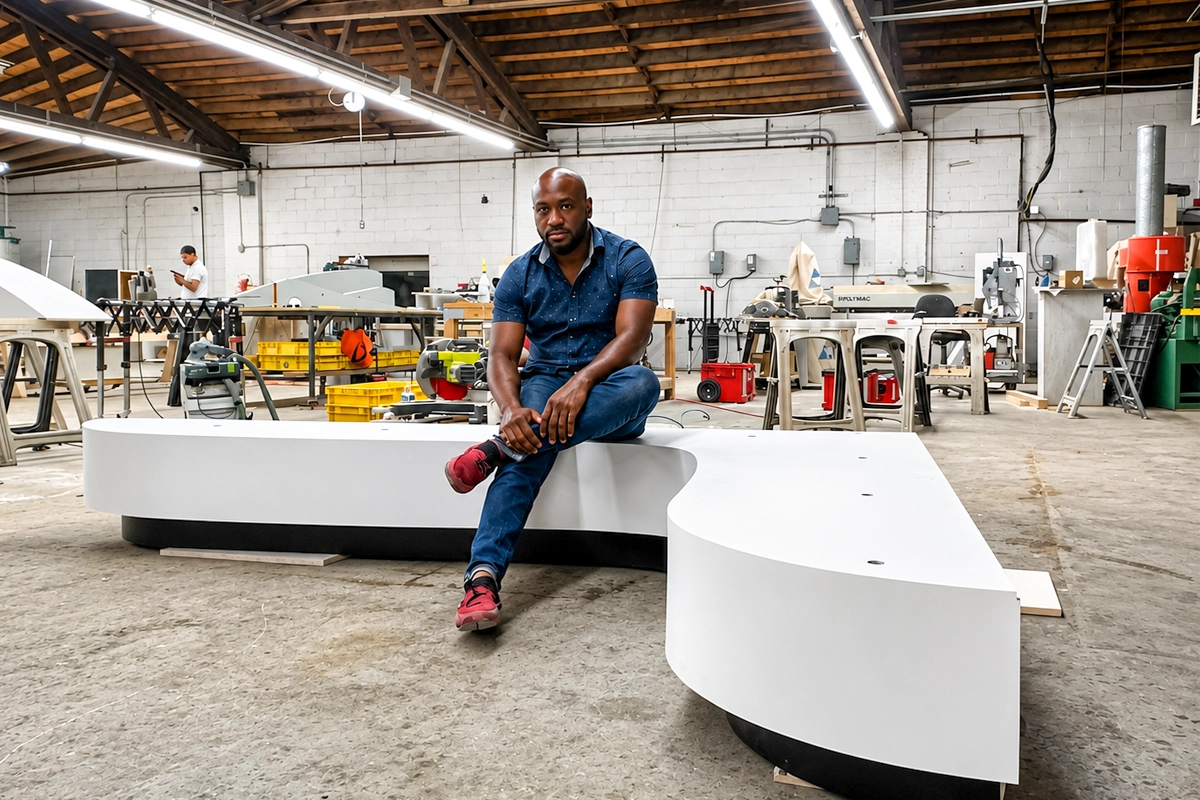
America’s densest cities prove one thing: every square foot matters. Every building must be designed with care to create a high-quality urban living experience, but more often than not, challenges arise. This is due to the inevitable construction chaos that comes with design and architecture — mistakes and miscommunication accumulate within a team, and the process often takes longer than it should. Architectural designer and founder of FatAtelier in New Jersey, Francis Fatade, has an answer: design-to-make innovation.
He explains: “I've created a new niche: 'design to make,' integrating robotic CNC and in-house fabrication into architecture. This empowers designers to move beyond paper, test ideas in real time, and execute with feedback loops.”
This kind of approach collapses the traditional divide between an architect and a builder. With design-to-make innovation, every project begins and ends under one roof: his studio. He plans everything with digital precision with his team, before proceeding with hands-on craftsmanship to deliver better-quality products, resulting not just in excellent work but happier clients.
The Jersey City Solarium: A Masterclass in Off-Site Precision
One project that proves the effectiveness of this strategy is the rooftop solarium in Jersey City: an oasis that managed to be designed despite tight urban site constraints. One could consider it as the purest expression of Fatade’s skill in modular expertise. It was first commissioned for a private residence, which so happened to overlook the Hudson River. The rooftop proved to be a challenge for all designers: the goal was to transform it into a serene year-round oasis. Instead of battling the tight site access, noise restrictions, and weather delays that come with typical urban builds, Fatade had a different vision. He took on a radically different approach, from conceptualization to execution, by using his design-to-make philosophy.
Instead of a traditional workflow that involves just designing and conceptualizing before handing it off to builders — which can increase delays through miscommunication and prototype failures — Fatade designed, fabricated, and finished everything at FatAtelier’s Newark facility before a single piece left the building.
It sounds intimidating, but for Fatade, it’s his passion at play. He confesses: “I don't see it as 'work'—it's fun in the studio.” He explains that it’s practically his everyday work and as a result, looms over his work ethic and life philosophy: “About 80% of my designs get manufactured
in-house using CNC machining, robotics, and 3D printing for precision beyond manual capabilities. This computer-to-fabrication workflow streamlines everything. My redefined niche in architecture emphasizes execution, not just documentation — designers should experiment and build their ideas.”
So far, the results have been looking breathtaking: there are floor-to-ceiling glass panels that frame panoramic views. Automated blinds make it easy to manage privacy and light control. The result is breathtaking: floor-to-ceiling glass panels frame panoramic views while automated blinds provide privacy and light control. The solarium integrates seamlessly with the existing building structure, serving as a harmonious extension that feels light, modern, and timeless.
Fatade ensured every bit of the rooftop solarium was built to the highest standards, with zero tolerance for error.
Modular Architecture in the Urban Reality
The rooftop solarium was made possible through one thing: modular architecture.
As a design approach, modular architecture breaks a single structure into modules: smaller, independent, standardized parts, all manufactured off-site before being assembled on-site. This allows the overall project to have increased speed, flexibility, and cost-efficiency. Every modular part has a well-designed interface, largely manufactured in a controlled factory environment before transportation and on-site installation.
Modular architecture is key to urban design because it completely redefines urban living. This kind of architecture solves core problems in city life: limited space, for one, alongside high construction costs. Modular architecture is well-known in the design of residential and commercial buildings, and for good reason: because the work is 90% off-site, the weeks of construction spent on scaffolding, street closures, and noise complaints are eliminated.
Fatade knows these benefits all too well. In addition, he uses digital workflows in modeling and rendering his designs to test every detail virtually before fabrication and execution begin.
For Fatade, it’s more than just delivering good work — he wants to tie it to a signature style of quality. He explains: “I want my spaces to carry my signature so strongly that people recognize 'Francis did this' instantly. Remembered for top-quality, efficient, premium work that gives exceptional experiences.”
This kind of passion and attention to detail is what made the Jersey City Solarium occupy its own niche in excellence. The space is fully insulated, weatherproof, and energy-efficient, with premium finishes that rival any ground-up luxury build, all while making use of an underused rooftop. It now serves as an example of the kind of adaptable living solution cities desperately need.

Behind the Work: Meet Fatade
Fatade, the man behind the design-to-make philosophy, is slowly redefining architectural and design norms. His history reflects his passion, to say the least: he began his journey into design
as a Nigerian teenager growing up around local tradespeople — carpenters, plumbers, and welders, for example. As a result, he picked up skills from various trades, which influenced his dream of becoming a mechanical engineer.
However, he was advised to take a variety of different routes. It’s no wonder. Fatade showed an early affinity for different trades, as he explains: “I was also an artist and sculptor, selling paintings and creating mixed-media works.”
Architecture seemed like the logical next step. He shares: “Combining my hands-on fabrication skills with my artistic talent made architecture the perfect fit. I pursued it, studied it, and found it incredibly fulfilling.”
As an architect and designer, Fatade’s main motivation is his passion for the work. It’s more than just planning out a space for him; it’s fulfilling, complex problem-solving. He admits this, saying: “First, I love designing—specifically, solving complex problems through design.
Problems seem to find me, and as an architect and designer, I can efficiently communicate solutions via my designs.”Every kind of space, to him, is something that can be controlled and transformed.
His early, hands-on training in various trades was combined with modern design technology, allowing his design skills to extend to buildings, interiors, furniture, and fittings. More than just designing structures, he also has a passion for designing objects and products. All of it boils down to improving people’s lives: “I cherish seeing people experience the final product or space.
The full cycle—from problem identification and design, through fabrication, to the end-user interaction—is deeply rewarding. It's about creating inspiring, boundary-pushing environments that enhance lives.”
One of his colleagues, KC Ochibili, a software developer, comments on his unprecedented skill level, saying: “If you removed all his employees, Francis could single-handedly handle every single facet of production himself. He'd be exhausted, but he could do it—design, fabrication, CNC operation, robotics, everything. His team exists to give him more time and capacity, but he's fully capable across the board. He's incredibly well-rounded: knowledgeable in business, design, software, 3D printing, robotics—you name it. That versatility and hands-on mastery make him brilliant.”
Stacy Ann Wilkins, a licensed real estate broker, notes: “The three greatest benefits from working with Fatade are his high energy, his genuine passion for design, and his unwavering positivity. He has benefited my business by turning difficult property constraints into high-end features that increase value.”
Meanwhile, Ali Hasan, Project Manager at SMART BUILD, says: “His attention to detail, especially in the engineering aspects like ensuring seamless and efficient millwork installation, really stands out.
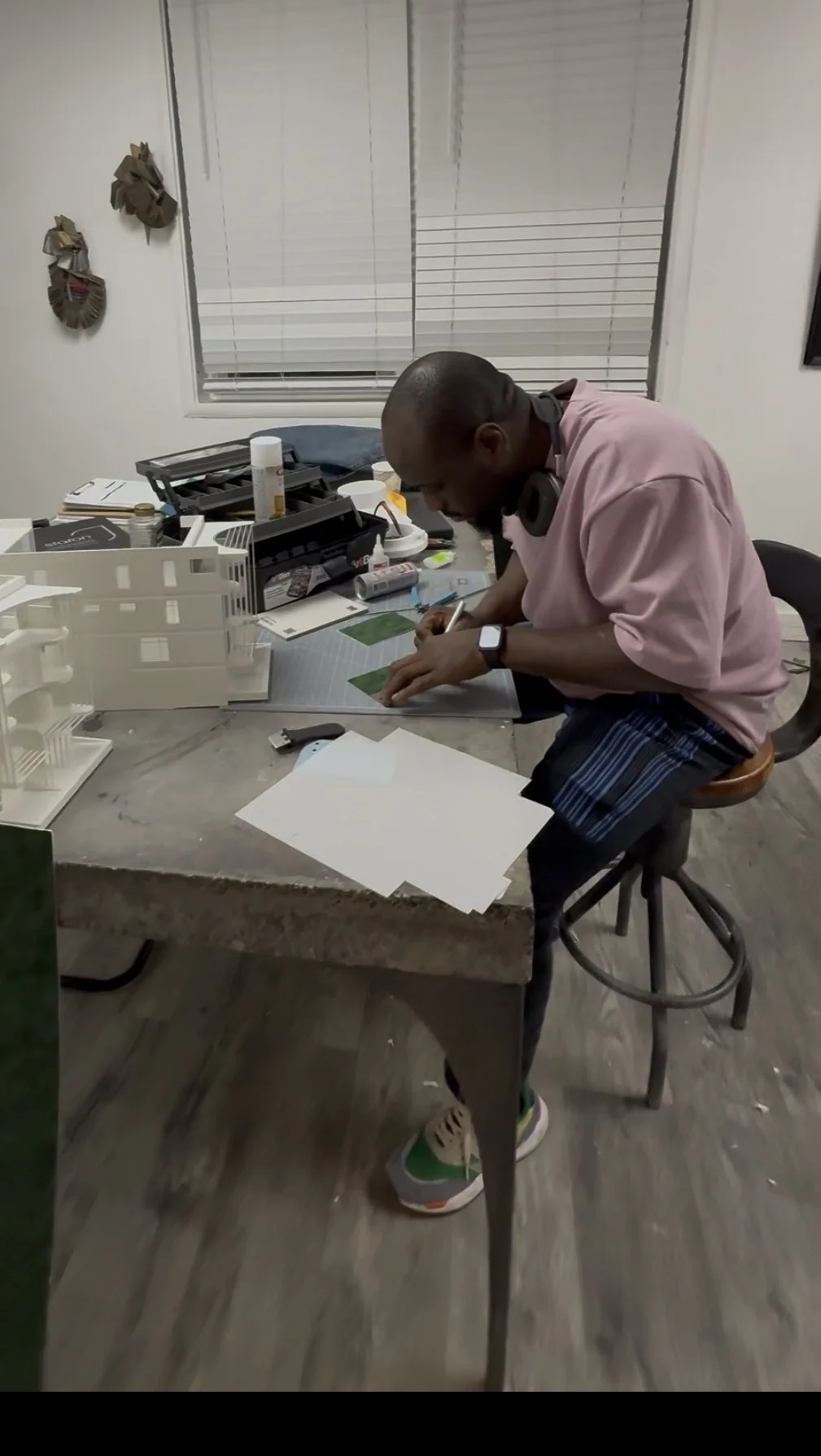
“Francis is incredibly reliable and professional, making him an absolute pleasure to work with on complex architectural projects. By standing firmly behind his work and maintaining the highest quality standards, Francis has greatly benefited our organization.”
He adds: “As a lead architect and designer, Francis excels at turning concepts into practical, high-quality realities through his dedication and skill.”
However, Fatade’s work ethic had to develop beyond just passion and capability. It was handling communication and management that became the top priorities in building with his team at FatAtelier.
He clarifies: “Design can be selfish—we architects impose our visions, believing our solutions best solve client problems. A recent project tested this: we delivered a fantastic design and execution, but the client journey to full satisfaction took longer than ideal due to management and communication dynamics.”
He continues: “We ultimately made the client very happy, but the process taught me the importance of guiding clients more patiently through change. Challenges like these refine leadership and client collaboration skills.”
Over the years, Fatade has proven his design and management skills to be top-notch. Currently, Fatade is a member of the American Institute of Architects (AIA) and actively participates in critiques and juries for competitions. He’s a winner himself, having received the Young African Architect Award in 2012. He has also worked with premium and high-profile clients seeking bespoke, innovative solutions. FatAtelier has collaborated with Rimowa, a leading luxury luggage brand, Sushi by Bou, multiple Hilton and Marriott hotels, and European Union-related projects in Africa.
At the end of the day, passion drives him above everything else to focus on providing solutions for his clients, as he says: “It's not about business or money—it's passion for the work. I wake up to solve problems, help people, improve processes, and create better outcomes. Do the job well first; the rest follows.”
Modular Architecture: The Future of Urban Living
Fatade is one of the very first designers to combine in-house digital fabrication with modular architecture at this kind of scale. He has also demonstrated how this approach cuts costs significantly, which has become one of its main benefits. However, Fatade positions modular architecture not as a budget shortcut but as one of the most sophisticated, site-responsive strategies for dense American cities.
Aside from what it offers in terms of space, reduced disruptions, speed, and budget, modular architecture is also more sustainable, flexible, and adaptable. Overall, there’s less material waste, and with urban architecture scaling and changing fast, the modular alternative allows everything to be expanded, reduced, and customized according to needs.
His design-to-make philosophy extends across his portfolio of quality work, from modular housing initiatives to veteran housing projects, all executed with the same in-house rigor. His work is featured in Anja Dispensary, the Museum of Illusion, Livingston Residence, Sushi by Bou, and Hampton Inn Lobby. He primarily delivered custom, innovative, and bespoke millwork, display shelves, and other interior components that span from enhancing presentations to full renovations.
By controlling the entire process — from initial consultation through fabrication to final crane lift and installation — Fatade delivers projects faster, cleaner, and with superior quality. In an era of skyrocketing urban real estate costs and construction delays, his design-to-make model offers a powerful alternative: beautiful, functional expansions that respect both the building and the city around it.
With Fatade at the helm, structures are already baked with solutions that designers just have to find, even in moments of possible crisis. He explains: “I believe every problem has a solution—we just haven't discovered it yet. I approach challenges optimistically and execute solutions efficiently. For example, on a recent project, we misaligned an installation by inches near a drain. The client was upset, but we designed, 3D-printed, and fixed it in under eight hours—turning a potential disaster into a quick win.”
All in all, Fatade’s work ethic, philosophy, and innovations in architecture and design, especially modular architecture, contribute to the transformation of urban living. Whatever new innovations may emerge, there is no doubt that he has played a role in pushing the future forward.
About the Author
Sandra Kelembeth is an experienced writer who specializes in healthcare, health technology, fitness, and sports. With a sharp attention to detail and a deep passion for wellness, she creates compelling content that educates, engages, and motivates her audience. Her writing skillfully simplifies complex medical concepts, making them accessible and relevant to everyday life. She is dedicated to empowering readers with practical knowledge that supports healthier, more informed lifestyle choices.






























.webp)
.webp)
.webp)



Comments
0 Comments