Tuesday, October 20, 2026
Business Honor
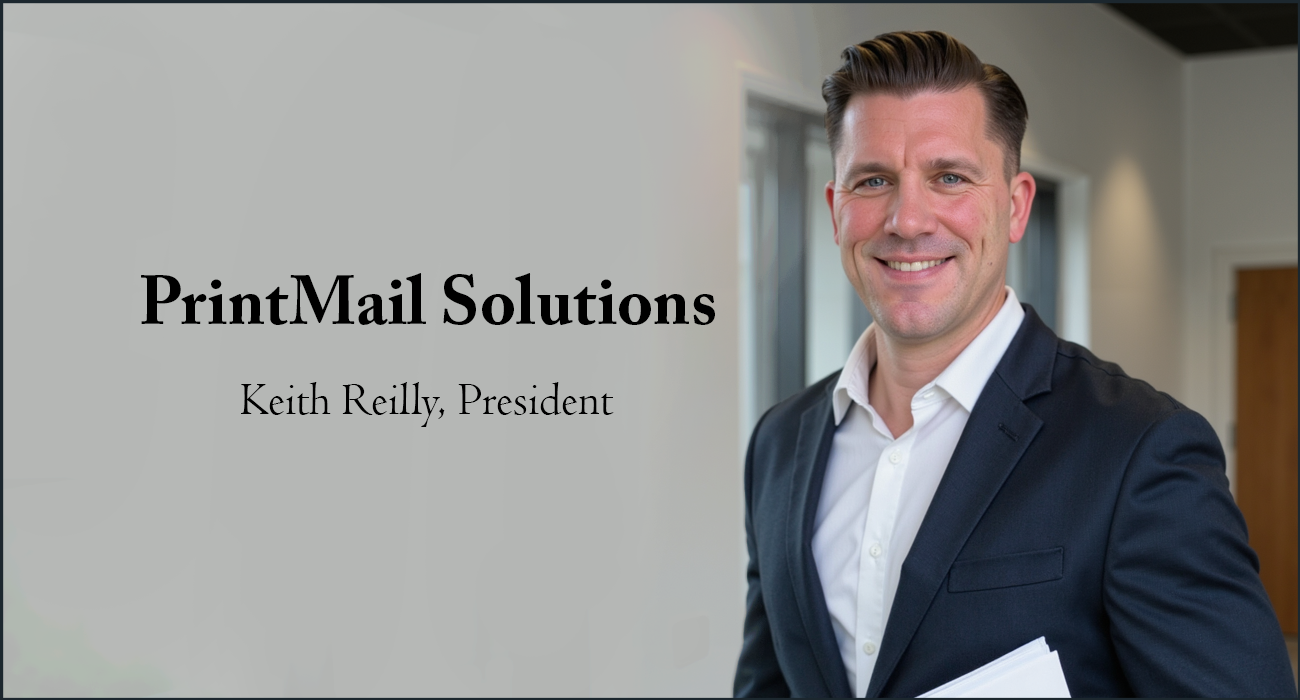
Since its founding in 1993, PrintMail Solutions has been guided by a vision that goes far beyond printing and mailing documents. Kevin Reilly founded the company after recognizing an opportunity to help organizations produce critical communications more efficiently. Still, the deeper purpose was to take a complex burden off clients’ shoulders and ensure it was handled correctly. That commitment to accuracy quickly became a defining principle of the business, particularly as organizations increasingly relied on physical statements and notices as essential customer touchpoints.
A pivotal breakthrough came in 2001, when PrintMail developed a solution for a community bank that preserved check images during the transition from physical checks to digital records. Solving that overlooked challenge opened the door to broader opportunities and reinforced the company’s philosophy of identifying problems others may not yet see. Today, PrintMail applies that same problem-solving mindset across critical communications, continually evolving its capabilities while remaining focused on one foundational promise: make the process easier for clients and get it right.
Interview Highlights with Keith Reilly
We manage the full lifecycle of a critical document — from the moment a data file leaves a client’s core system to the moment it lands in a mailbox or an inbox.
That covers statement processing for deposit, loan, trust, and investment accounts. Compliance communications and regulatory notices. Tax form processing on statutory deadlines. Interactive eStatements and digital presentment. Custom document design and statement redesign. Direct mail marketing with inserts, onserts, and creative services. And through our BankBound team, digital marketing for brands in regulated industries.
The simplification comes from consolidation. Most organizations we meet are running critical communications across four or five disconnected relationships — one vendor for statements, another for tax forms, an internal team handling notices, and a separate platform for eStatements that never quite reconciles with print. Every handoff between those parties is a place where something breaks, and nobody owns it.
When it all runs through one pipeline, delivery preferences live in one place, print and digital stay synchronized, marketing messages can actually be targeted using the same data that drives the statement, and there’s a single accountable party when a question comes up. Our clients typically reduce print and mail costs by up to 20% when they outsource to us — but the cost savings usually isn’t what they talk about a year later. What they talk about is not thinking about it anymore.
The needs have shifted toward more complexity, less staff, and higher stakes.
On statement processing, documents have become more complex, with variable page counts, household grouping logic, multi-account relationships, and rising accessibility requirements. Meanwhile, the operations teams responsible for them have become smaller. Our job is to absorb that complexity rather than pass it back.
On eStatements, the industry spent years treating digital delivery as a cost-reduction lever, often producing experiences customers did not adopt. We treated it as an experience problem instead. Our clients see eStatement adoption rates up to twice the national average by making the digital document genuinely better than paper—searchable, interactive, and with marketing content the institution controls.
Tax forms are their own discipline. With no flexibility in an IRS deadline, we treat year-end as scheduled production work with expedited onboarding, not an annual emergency.
We’ve invested heavily in integrating on our side of the line — more than fifty platform integrations today, with a development team dedicated to it. When an institution runs on a major core system, we’re typically already connected to it, which turns what could be a six-month integration project into a configuration exercise. When a client is on something less common, we build to it. Either way, they aren’t maintaining custom middleware.
Downstream, the same data drives both print and digital. That sounds obvious, but in most organizations it isn’t true — print runs off one file, the eStatement platform off another, and the two drift. When delivery preferences, suppression rules, and document content all originate from a single pipeline, print-to-digital migration becomes something an institution can actually manage. They can move customers to electronic delivery confidently, because the counts reconcile and nobody falls through a gap.
On top of that, we’ve built the visibility layer clients ask for: a customer portal for job status, full-service Intelligent Mail Barcode tracking so documents can be traced to delivery, address quality management, and archiving with retrieval designed around how auditors and legal teams actually request documents. When an examiner asks what was sent, to whom, and when — sometimes years later — the answer takes minutes.
The most common one is that critical communications are simultaneously mission-critical and nobody’s full-time job. They sit with an operations team that has ten other responsibilities, until something goes wrong and suddenly it’s everyone’s priority.
Our approach is to start with a cost analysis and a workflow review before proposing anything. We’ve done these for hundreds of organizations, and they consistently surface things the client didn’t know — redundant mailings, suppression rules that stopped working, postal presort savings being left on the table.
It’s the whole thing, honestly. In a business where the technical capabilities across serious providers are more similar than different, service is the differentiator — and it’s the one clients cite most when they tell us why they stayed.
Every relationship begins and ends with a dedicated client manager. Not a ticket queue, not a rotating rep — a specific person who knows that institution’s file formats, cycle calendar, quirks, and history. Our clients describe it as having an extension of their own team, and that’s the intent. We also conduct periodic Executive Business Reviews covering the performance of the document delivery program, so the conversation isn’t only reactive. The result is relationships measured in decades rather than contract terms.
First, deepening the print-to-digital bridge. Digital adoption is still well short of where institutions want it, and the barrier isn’t customer willingness — it’s experience quality and enrollment friction. We’re continuing to invest in making the electronic document the preferred channel rather than the cheaper one. Our clients already see adoption at up to twice the national average, and we think there’s meaningful room above that.
Second, expanding integrations and automation. Every new platform we connect to removes work from a client’s IT team. We’re also automating more of the exception handling that currently requires human intervention — address issues, file anomalies, suppression conflicts — so problems get resolved before anyone notices them.
Short Bio – Keith Reilly
Keith Reilly serves as President of PrintMail, leveraging 14 years of leadership to guide the organization to prominence in digital and print document composition and delivery services. His strategic vision and client-focused approach have expanded PrintMail’s capabilities across the financial services, healthcare, insurance, automotive, and utility sectors, driving growth while sustaining the company’s reputation for accuracy and reliability.
Keith is a United States Marine Corps veteran of Operation Iraqi Freedom and holds an MBA from Penn State University. He represents the second generation of family leadership at PrintMail, which was founded by Kevin Reilly in 1993.

































.webp)

.webp)



.webp)